How EU Importers Build Long-Term Supplier Relationships with Chinese Fruit Farms
For a European fruit importer, the decision to source from China is usually not about finding the cheapest product. It is about finding a supply chain that will still be standing three seasons from now.
The commercial case is straightforward. Between January 2022 and March 2026, China accounted for 37.4% of extra-EU imports in the “other fruits” category, making it the single largest non-EU supplier. China-EU agricultural trade reached $11.94 billion in the first five months of 2026 alone, with fruit and fruit preparations up 19.7% year-on-year. The volume is there. The question is how to build a relationship that converts that volume into reliable, repeatable shipments.
What follows is not a theoretical framework. It is a sequence of decisions that experienced EU importers actually work through, and an honest assessment of what Chinese farms need to demonstrate at each stage.
The Commercial Case: Volume, Growth, and the Search for Stability
For a European fruit importer, the decision to source from China is usually not about finding the cheapest product. It is about finding a supply chain that will still be standing three seasons from now.
The commercial case is straightforward. Between January 2022 and March 2026, China accounted for 37.4% of extra-EU imports in the “other fruits” category, making it the single largest non-EU supplier. China-EU agricultural trade reached $11.94 billion in the first five months of 2026 alone, with fruit and fruit preparations up 19.7% year-on-year. The volume is there. The question is how to build a relationship that converts that volume into reliable, repeatable shipments.
What follows is not a theoretical framework. It is a sequence of decisions that experienced EU importers actually work through, and an honest assessment of what Chinese farms need to demonstrate at each stage.
The Entry Ticket: Certifications and Traceability Audits
The vetting process starts before any sample is requested. For EU importers, the compliance landscape is not optional, and the starting point is food safety certification.
GLOBALG.A.P. is the effective minimum. The Centre for the Promotion of Imports from Developing Countries (CBI) is unambiguous on this point: GLOBALG.A.P. certification is “a minimum requirement for doing business with European buyers”. This is not a marketing preference. Retail chains in Germany, the Netherlands, and the UK will not list fresh produce from a farm that cannot provide a valid GGN number.
But certification alone is insufficient. During the audit phase, importers look at what sits behind the certificate. A practical due-diligence protocol for fresh produce suppliers includes requesting 12 months of ISO 17025-accredited MRL test certificates, and any reluctance to provide these is treated as a red flag. The importer is not just checking whether residues are below limits. They are checking whether the farm has a functioning system for monitoring them.
Traceability is the other baseline expectation. EU food law requires that trade packages of fresh fruit carry a lot number for traceability, and if the farm is GLOBALG.A.P. certified, the GGN should appear on the label. For a Chinese farm preparing for an EU audit, the practical implication is that spray records, harvest logs, and packing records need to be cross-referenced and retrievable within a reasonable timeframe. If an importer asks for the spray history of a specific lot, “we will check with the farm” is not an acceptable answer.
Trial to Scale: Pre-Shipment Inspections and Packaging Compliance
A European importer rarely opens with a full container. The first order is typically a pallet-level trial, sometimes split across two or three varieties. The purpose is not to test the product in isolation. It is to test the exporter's operational discipline under real conditions.
What importers watch for during a trial order:
Pre-shipment inspection access. The importer will usually arrange for a third-party inspection—SGS, BV, or Eurofins—before the container is sealed. The farm's willingness to accommodate this, and the condition of the fruit at the time of inspection, tells the importer more than any quality claim.
Packaging compliance. EU labelling requirements for trade packages are specific: name and address of the packer, product name and variety, country of origin, class and size, and lot number for traceability. If a Chinese exporter arrives at the trial stage with packaging that does not meet these basics, the importer will assume the same inattention will apply to larger orders. Inadequate labelling can lead to fines and recalls, and if the importer is forced to relabel boxes in Europe, the labour cost is significantly higher than in China and will typically be deducted from the exporter's invoice.
Cold-chain documentation. For perishable fruit, the trial shipment is also a cold-chain trial. Importers expect temperature recorder data to be available after arrival, not just a verbal assurance that the reefer was set correctly. The data either shows a stable temperature curve or it does not.
A trial order that arrives on spec, on time, and with complete documentation does more to build trust than a year of email correspondence.
Beyond the Red Sea: Extended Transit Times and Cold-Chain Risk
Any discussion of EU-China fresh fruit trade that ignores the current shipping environment is incomplete.
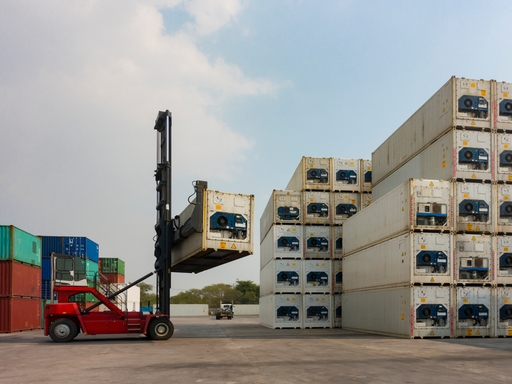
Since the Red Sea disruptions that began in early 2024, transit times from China to major European ports have extended from roughly 25 days to 70–90 days, with arrival windows increasingly difficult to predict. This is not a temporary inconvenience. It has reshaped how importers evaluate supplier reliability.
For a Chinese farm, the practical consequences are threefold.
First, harvest timing and vessel booking need to be coordinated with far less certainty. A farm that can adjust harvest windows or hold fruit in controlled conditions when a vessel is delayed has a material advantage over one that cannot.
Second, cold-chain performance over 70–90 days is a different technical challenge than over 25 days. The margin for temperature fluctuation is narrower. Importers will scrutinise reefer data from trial shipments with this in mind.
Third, market timing becomes harder to protect. When shipments arrive in concentrated clusters, European wholesale prices can soften quickly. An exporter who communicates proactively about potential delays—rather than waiting for the importer to discover them—preserves the relationship far better than one who goes silent.
The Communication Test: Why Responsiveness Outweighs Price
The most common failure mode in EU-China supplier relationships is not quality. It is silence followed by a problem.
Experienced importers do not expect every shipment to go perfectly. They expect the supplier to tell them when it does not. A farm that provides a dedicated English-speaking contact, uses WhatsApp or WeChat for real-time updates during packing and loading, and flags issues before they escalate is signalling operational maturity.
The corollary is also true. When an importer asks for a document, a photo of the packing line, or a temperature log and receives a response within hours rather than days, that responsiveness becomes part of the supplier's value proposition. Over time, it is often what keeps the relationship intact when a cheaper competitor appears.
Contract Structures: Moving from Fixed Pricing to Index-Linked Models
Once a supplier has cleared the trial phase and demonstrated consistent communication, the relationship moves toward a contractual framework. The structure of that framework has shifted in recent years.
Rigid, fixed-price annual contracts are becoming less common. Importers increasingly favour volume commitments with pricing mechanisms linked to market indices, combined with clear force majeure provisions that account for the logistical volatility described above. For the Chinese farm, this means accepting that the price will not be fixed for twelve months, but gaining something more valuable: a predictable volume commitment that justifies investment in packaging, cold-chain infrastructure, and certification maintenance.
The relationship is also increasingly bilateral. A Chinese farm that understands the importer's downstream market—the retail channels, the consumer segments, the seasonal demand patterns—is better positioned to suggest adjustments in variety mix, packaging format, or shipping schedule that benefit both sides. That kind of input is what turns a supplier into a partner.
Documentation Checklist: Phytosanitary Certificates and MRL Pitfalls
For farms preparing for their first EU shipment, two documentation points deserve particular attention.
Phytosanitary certificates. Almost all fresh fruit entering the EU requires a phytosanitary certificate. Recent amendments to EU plant health regulations have added additional declaration requirements for certain products, including citrus from specific origins, effective from October 2026. Chinese exporters should verify current requirements for their specific product and region with the EU’s Access2Markets tool before booking shipment.
MRL alignment. The EU maintains an online MRL database that allows exporters to search by product and active substance. Some EU member states, including Germany, the Netherlands, and Austria, apply MRLs stricter than the harmonised EU level. If the importer’s primary market is one of these countries, the farm needs to be working toward the stricter standard, not the EU baseline.
The Bottom Line: Why Reliability Outlasts Price in the EU Market
The commercial fundamentals of Chinese fruit exports to the EU are strong and improving. What determines whether a specific importer-farm relationship survives is not the price of the first container. It is whether, after the first container, the importer has reason to believe the second one will be easier.
That belief is built on certification that holds up to audit, documentation that matches the shipment, a cold chain that performs over 70-plus days, and a communication style that treats problems as shared rather than hidden. Farms that can demonstrate all four are not competing on price. They are competing on reliability, and in the EU import market, that is a more durable advantage.