
Hidden costs you may overlook when importing fruit from China to Europe
When calculating the cost of importing fruit from China, most buyers focus on the product's ex-factory price, ocean freight, and tariffs. These three components make up the visible figures on a quotation and are the easiest parts to quantify in financial models. However, what truly erodes profit margins are often not these explicit costs, but rather the hidden expenses that aren't included in the budget at the time of contract signing.
Compliance and Inspection: More Than Just Testing Fees
The compliance costs for fruit imports extend far beyond the nominal fee for a phytosanitary certificate.
For EU buyers, third-party inspection costs must be considered for every shipment prior to loading. A standard pre-shipment inspection typically ranges between $199 and $320. For a $20,000 order, this may seem like a significant additional expense. But if ignored, the risks upon arrival at port include daily storage fees of €150 to €300, return shipping costs exceeding €3,000, and the complete loss of commercial value due to spoilage.
A more subtle compliance cost lies in the alignment of testing scope. Not all third-party testing agencies have the capability to test according to EU Maximum Residue Levels (MRLs). If suppliers conduct tests based on China’s GB standards, the results may not be accepted at EU ports. Certain product categories require specialized testing—for example, 4-CPA and propiconazole in wax apples, or chlorpyrifos and acetamiprid in tea. Such specific tests usually incur extra costs and time, and failing to allocate budget for them could mean last-minute retesting won’t be completed before the vessel departs.
Another frequently overlooked compliance step is verification of GACC registration and export orchard registration. China Customs requires registration for both export orchards and packing plants. Orchard registration criteria include a minimum contiguous planting area of 100 mu (about 6.7 hectares), no pollution sources nearby, a plant protection officer responsible for monitoring and controlling pests, a quality management system, and no major plant disease outbreaks in the past two years. Packing plants must have facilities meeting quarantine requirements for cleaning, processing, and pest control, with water and agricultural chemicals used conforming to the importing country’s regulations. Registration certificates are valid for three years.
If your supplier cannot provide valid registration information, or if the registered facility address does not match the claimed orchard or packing plant, it means their production site has never undergone customs’ on-site audit. This gap must be filled by additional third-party inspections, which differ significantly from customs audits in both coverage and depth of information.
Cold Chain and Packaging: Costs Beyond Freight
Ocean refrigerated container freight represents only part of the cold chain cost. Energy consumption during pre-cooling, power surcharges for refrigerated containers, and packaging material choices all significantly impact the final cost.
Take pre-cooling—the starting point of the cold chain—as an example. Different fruits have different pre-cooling time windows. For export-grade Sunlight Rose grapes, the process requires cooling the fruit to 4–6°C within 1.5 hours after harvest. In Liangshan, Sichuan, export-quality grapes demand even stricter handling: they must enter a 0°C pre-cooling room within two hours after harvest, with core temperature rapidly reduced to 4°C, and maintained at 4°C throughout transportation. Any delay in pre-cooling leads to softening of fruit, stem browning, and moisture loss, which continue to accumulate during subsequent refrigerated transport—something refrigerated containers cannot reverse.
Packaging materials also affect cost structure. Take wax apples as an example: their shelf life is extremely short, requiring air transport, and packaging must use nitrogen flush technology to replace oxygen inside the package, slowing oxidation and decay. Under refrigeration, this method can extend freshness by up to 10 days. The cost of this packaging is significantly higher than that of ordinary cardboard boxes or plastic crates, but in the commercial model for wax apples, this expense cannot be reduced—because once the packaging fails, the remaining shelf life of the entire shipment may no longer support commercial sales.
For grapes, using slow-release sulfur dioxide pads to control gray mold disease, although SO₂ itself is not expensive, means the containers cannot be shared with any other fruit. This implies you may have to pay higher freight rates for an entire container without being able to share costs through consolidation. The cost advantage of mixed-container shipping is thus offset by the incompatibility of SO₂, a hidden cost often not proactively disclosed by suppliers during quotation.
For onions, the use of ventilated refrigerated containers is essential for cold chain management. Onions require low humidity (65% to 70% relative humidity), not just low temperature. If sealed refrigerated containers are used, moisture generated by respiration cannot escape, leading to condensation on the container walls. When onion skins absorb this moisture, it directly triggers root sprouting and neck rot. Ventilated containers typically incur higher freight charges than standard refrigerated containers, and this price difference represents a real yet easily overlooked cost in onion procurement.
Port and Customs: Demurrage and Return Costs
When goods arrive at EU ports, beyond standard tariffs and VAT, hidden costs begin to emerge.
If the cargo is selected for inspection, customs clearance time extends, and demurrage fees for refrigerated containers at port are charged daily, usually ranging from 150 to 300 euros per day. If inspection results are unsatisfactory, the goods face either return or destruction. The logistics cost of returning a 40-foot refrigerated container—including reloading, transportation, and documentation—can easily exceed 3,000 euros.
A deeper impact comes from RASFF notifications. Once a supplier appears in the RASFF system, subsequent shipments from the same source face increased inspection frequencies. For vegetable categories, the EU has already implemented enhanced inspection measures for specific products originating from China, with inspection rates far exceeding normal levels for certain items. The impact of such records can span an entire production season, and increased inspection frequency means longer waiting times at every customs clearance. This represents a hidden占用 of working capital—one difficult to quantify in budgets but very real.
Finance and Insurance: Hidden Financial Costs Behind Documents
Payment terms and exchange rate fluctuations are financial hidden costs often overlooked.
Take letters of credit as an example. Bank fees for LCs typically range from 0.5% to 1.5% of the transaction value, depending on the issuing bank’s fee structure and the LC term. Referring to the fee schedule of Bank of China, Milan Branch, the opening fee for import LCs is 0.3% per quarter (minimum 50 euros), amendment fee is 30 euros, and discrepancy fee is 50 euros. For a 100,000-euro LC, the opening fee alone could exceed 300 euros, and when adding potential amendment and discrepancy fees, actual expenses may approach 1% of the transaction value.
If the buyer's purchase volume does not justify frequent use of LCs, T/T wire transfers may have lower bank fees, but the opportunity cost of tied-up funds must be calculated separately. A 30% deposit means this amount cannot be used elsewhere during the supplier’s production cycle. For importers needing to maintain working capital liquidity, this cost must be factored into procurement decisions.
Insurance coverage is another frequently overlooked financial hidden cost. Many basic cargo insurance policies explicitly exclude losses caused by "temperature changes" unless the policyholder specifically adds coverage for refrigerated goods via an endorsement. If your policy does not cover cross-contamination losses in mixed-container scenarios, a single cargo loss could result in full out-of-pocket payment.
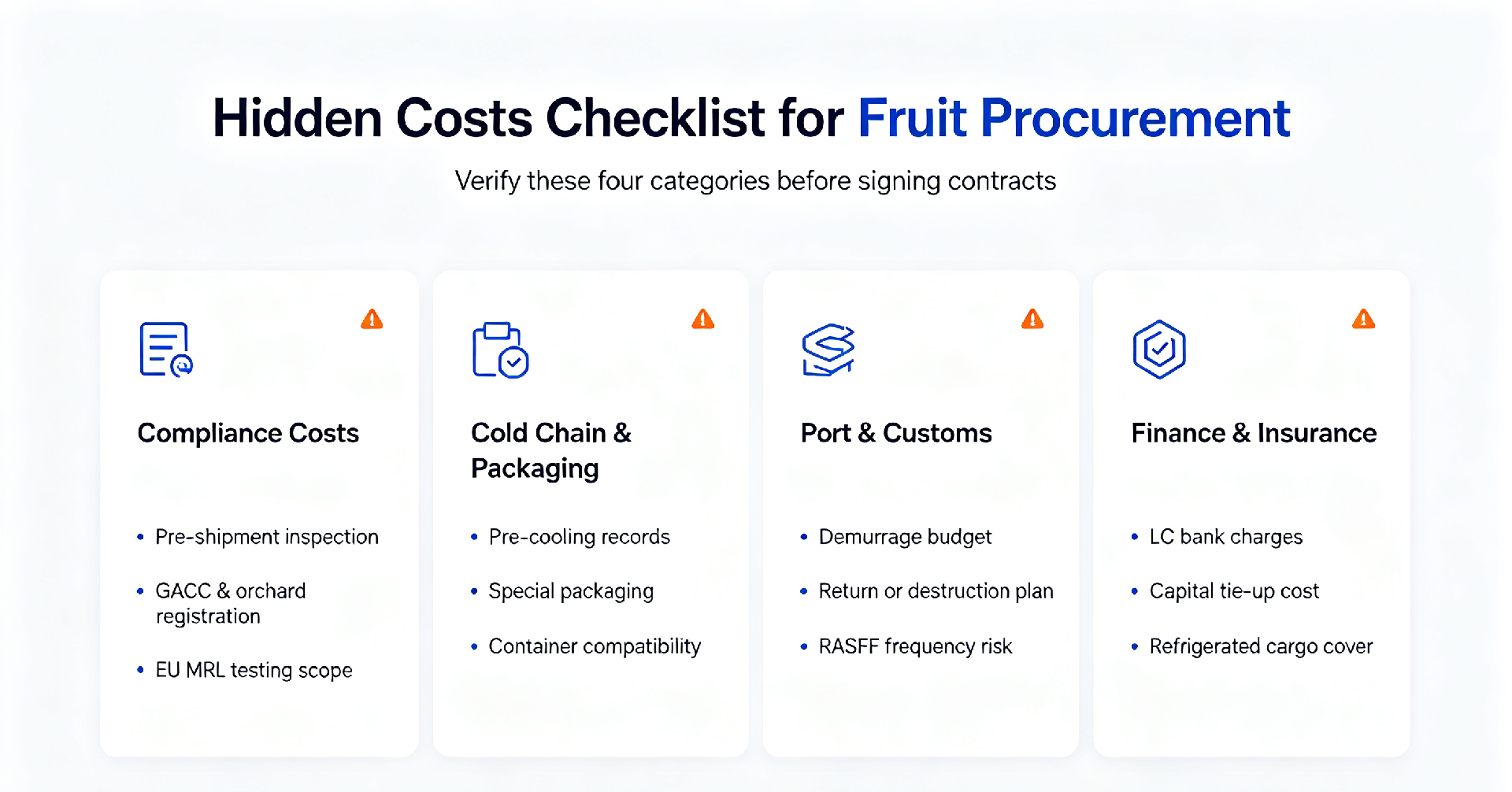
List of Hidden Costs to Verify Before Procurement
Compliance Costs
1.Has the pre-shipment inspection cost (including specific testing for active substances with RASFF historical notifications) been included in the procurement cost?
2.Are the supplier's GACC registration and export fruit orchard registration valid, and does the registered facility address match the claimed orchard or packing plant?
3.Have phytosanitary certificates and labeling compliance passed pre-audit?
4.Do the testing methods of the inspection agency clearly align with EU MRLs rather than China's GB standards?
Cold Chain and Packaging
1.Is the fruit pulp or vegetable core temperature at the end of pre-cooling recorded as an attachment to the contract?
2.Are the costs of special packaging (e.g., nitrogen flush preservation for wax apples, SO₂ slow-release pads for grapes) included in the quotation?
3.Will the container consolidation plan be unfeasible due to SO₂ treatment or ethylene conflicts? If so, what is the shared cost per full container?
4.For onions, are ventilated refrigerated containers used instead of sealed ones?
Port and Customs Clearance
1.Is the budget for refrigerated container demurrage sufficient (recommended estimate: 200–300 euros per day)?
2.Are emergency plans and cost ceilings for returns or destruction clearly defined?
3.Does the supplier have any history of RASFF notifications? If so, will the inspection frequency for subsequent shipments increase?
Finance and Insurance
1.Has the capital tie-up cost in the payment terms been reflected in the profit calculation?
2.Have bank charges for letters of credit (issuance, amendment, discrepancies) been included in the cost accounting?
3.Does the cargo insurance cover temperature control failure and cross-contamination? Does the base policy exclude losses due to temperature fluctuations?
The profit margin for importing fruits from China to Europe depends on the ability to manage these hidden costs. Only buyers who can quantify each of these costs before procurement and lock them into contracts will gain truly sustainable advantages during port clearance and final sales