
Which payment terms are safest for EU buyers sourcing fresh goods from China?
Let’s be clear: there is no single “safest” payment term. There is only a structure that matches the risk profile of your specific transaction. What works for a €20,000 trial order from a new supplier is very different from what works for a €200,000 seasonal contract with a supplier you’ve audited three times.
What follows is a practical breakdown of the main options, with the trade-offs stated plainly—and the specific pitfalls that matter when the product is fresh.
The EU Legal Framework That Most Buyers Don't Know Applies
Before getting into banking mechanics, there’s a regulatory layer that Chinese suppliers exporting to the EU should be aware of—and that EU buyers can use as leverage.
EU Directive 2019/633 on unfair trading practices in the agri-food supply chain applies to suppliers located outside the EU when they sell to EU buyers. It prohibits, among other things, payments later than 30 days for perishable products.
This means that if a Chinese supplier is exporting fresh produce to an EU buyer, and that buyer unilaterally insists on 60- or 90-day payment terms, that is technically a prohibited practice under EU law.
For EU buyers reading this, the reverse implication is also relevant. If you are asking a Chinese supplier to extend 90-day terms on a perishable shipment, you are asking them to carry a risk that EU law itself recognises as unfair. A supplier who agrees to those terms is either desperate or pricing that risk into the product cost. Either way, it should trigger a closer look at the transaction.
The same directive also prohibits short-notice cancellation of perishable orders and unilateral contract changes. For a fresh produce transaction where the product has a shelf life measured in days, these protections matter more than they do in general trade.
T/T: The Default That Works Until It Doesn't
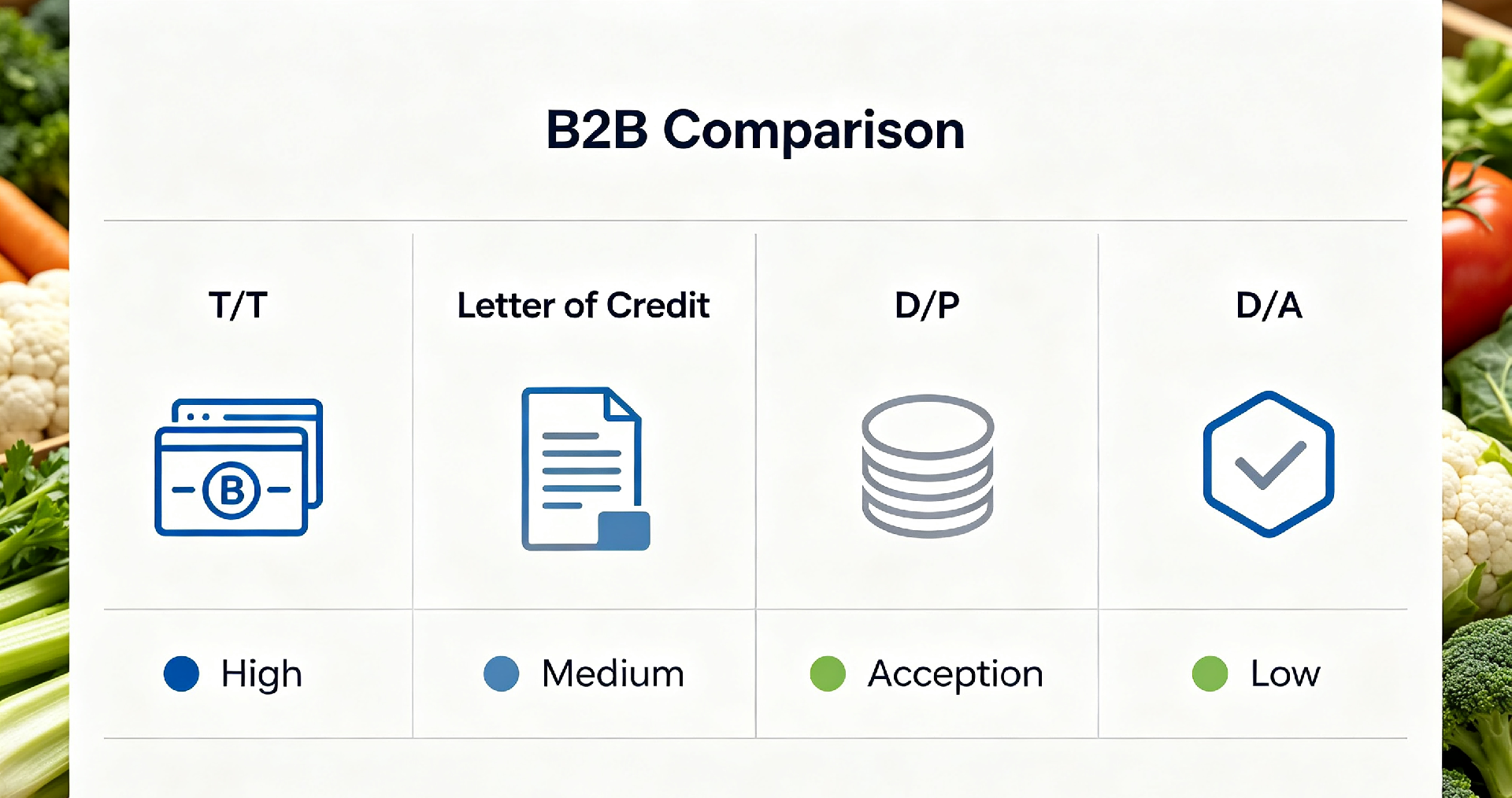
Telegraphic Transfer is the most common payment method in China sourcing, and for good reason: it’s fast, cheap, and accepted by virtually every supplier. The standard structure is 30% deposit to start production, 70% against a copy of the bill of lading.
The problem with T/T is that once the deposit leaves your account, you have no direct control over the funds. If the supplier ships non-compliant goods or doesn’t ship at all, your recourse is limited to legal action in China—an expensive and slow process for a single container of produce.
Where T/T works is in established relationships. If you have verified the supplier’s export registration, audited their cold chain, and confirmed their history of EU compliance, a 30/70 structure is reasonable. The deposit amount should be sized so that losing it would be annoying but not business-threatening. For a first order with a new supplier, a pure T/T structure is the riskiest option available.
One practical variant worth considering: 70% against a copy of the bill of lading, with the remaining 30% released only after the third-party pre-shipment inspection report is confirmed. This ties the final payment to a verifiable quality checkpoint rather than to the act of shipment alone.
Letter of Credit: Protection That Comes With a Paperwork Burden
A Letter of Credit shifts the transaction from “trust the supplier” to “trust the documents.” The supplier gets paid when they present a compliant set of documents to the bank; you gain assurance that the goods were shipped as agreed before the money moves.
For fresh produce from China, the LC structure has two specific challenges.
First, the presentation period. UCP 600 defaults to 21 days after shipment for document presentation. For perishable goods moving by sea from China to Europe—a voyage of 30 to 45 days—21 days is workable. But if the goods are air-freighted or if the route is short, the paperwork can move slower than the product. In those cases, the presentation period needs to be tightened to 5-7 days after shipment. If the LC says 21 days and your goods arrive in Rotterdam before the documents arrive at the bank, you’re stuck.
Second, the document requirements. The more documents you require, the more opportunities for a discrepancy that delays payment. For fresh produce, the essential documents are the commercial invoice, packing list, full set of clean on-board bills of lading, phytosanitary certificate, and—for CIF/CIP terms—an insurance certificate. Temperature settings can be noted on the bill of lading if the carrier is willing to state them, but don’t over-engineer this. Every extra document clause is a potential discrepancy.
An LC is most useful when the order value is high enough that the bank fees (typically 0.5% to 1.5% of the transaction value) are justified, and when the product specification is complex enough that you want documentary verification before payment.
D/P and D/A: The “Cash Against Documents” Trap
Documentary collection—D/P (Documents against Payment) and D/A (Documents against Acceptance)—is sometimes presented as a middle ground between T/T and LC. It is not, for fresh produce.
Under D/P, the buyer’s bank releases the shipping documents only after the buyer pays. Under D/A, documents are released against acceptance of a time draft. In theory, this gives the supplier more control than a pure open account.
In practice, D/P has a specific failure mode that is particularly dangerous for perishable goods. If the buyer refuses to pay at the port—because the market price has dropped, or because they’ve found a cheaper supplier—the goods sit at the port. For a refrigerated container of fresh vegetables, every day of delay reduces the value. The supplier is then faced with the choice of paying to return the goods, abandoning them, or accepting whatever price the buyer offers. The “cash against documents” protection is meaningless when the alternative is watching the product rot.
D/A is worse. The buyer gets the documents before paying, which means they can take delivery of the goods and then decide whether to honour the draft at maturity. For a fresh produce transaction with a first-time buyer, D/A is essentially an unsecured credit sale.
Where Third-Party Verification Fits Into the Payment Structure
The payment term is not the only control mechanism. A well-structured transaction uses payment milestones tied to verifiable checkpoints.
For fresh produce from China, the most important checkpoint is the **pre-shipment inspection**. This should happen before the container leaves the port, not after arrival in Europe. The inspection should cover pesticide residue screening against the EU MRL for the specific commodity, confirmation of cold chain pre-cooling records, and a visual check of the product against the agreed specification.
If the payment structure is 30/70 against the bill of lading, the 70% should be released only after the inspection report is confirmed. If the inspection fails, the payment is withheld and the supplier has an incentive to correct the issue before shipment—or the transaction is cancelled with the deposit as the supplier’s compensation for production costs already incurred.
This is where a Letter of Credit has a structural advantage: the inspection certificate can be made a required document under the LC, which means the bank will not release payment unless it is presented. The downside is that if the certificate is issued after shipment, the LC terms need to accommodate the timing.
Export Credit Insurance: The Option Buyers Rarely Consider
Most of the discussion about payment risk focuses on the buyer’s exposure. But there’s an instrument that works from the supplier’s side and, indirectly, gives the buyer more flexibility: export credit insurance.
Sinosure, China’s official export credit insurer, provides short-term credit insurance for agricultural exports. When a Chinese exporter is covered by Sinosure, they can offer more flexible payment terms—extended credit, open account, or deferred payment—because their risk of non-payment by the buyer is insured. For the EU buyer, this can mean access to better terms than a supplier would otherwise offer.
The mechanism works like this: the Chinese exporter applies for a credit limit on the EU buyer. If Sinosure approves the limit, the exporter can ship on open account terms with the knowledge that if the buyer defaults, Sinosure covers a percentage of the loss. Sinosure also provides buyer credit assessments, which can be useful for the exporter in deciding whether to extend terms.
For a €100,000 order, Sinosure coverage might allow a supplier to offer 30-day or 60-day terms where they would otherwise insist on T/T before shipment. The cost of the insurance is typically borne by the exporter, but it is often reflected in the quoted price. The buyer’s benefit is not a lower price—it is the ability to preserve working capital and to verify the shipment before payment is due.
What I Would Actually Do for a First Order
If I were an EU buyer placing a first order with a Chinese fresh produce supplier, the structure would depend on the order value.
Under €50,000:Use T/T with a structure of 30% deposit and 70% against the bill of lading, with the condition that the 70% is released only after a pre-shipment inspection report from a mutually agreed third party (SGS, BV, or Intertek) is confirmed. The inspection should include MRL screening for the relevant commodity and a cold chain temperature check. This adds perhaps €800-1,500 to the transaction cost, but for a first order it’s the cheapest insurance available.
Over €100,000:Use a Letter of Credit with a 7-day presentation period after shipment, requiring the commercial invoice, packing list, full set of clean on-board bills of lading, phytosanitary certificate, and pre-shipment inspection certificate as the document set. The LC gives both sides a clear process and the bank acts as an independent verifier of the documentary compliance.
Repeat orders with a verified supplier:Move toward 20/80 or 100% against the bill of lading, and consider whether the supplier’s Sinosure coverage allows for more flexible terms. At that point, the relationship risk is low enough that the cost of the LC or the inspection can be reduced.
The principle that applies across all of these structures is the same: never let the amount you have paid out exceed the amount of verifiable evidence you have that the goods are compliant and shipped. If you’ve paid 30% and you have no inspection report, no shipping documents, and no verified export registration, you’re not managing risk—you’re hoping.
A Final Note on Verification Before Payment
One thing that applies regardless of the payment term: before you send any money to a Chinese supplier, verify their registration on the GACC (General Administration of Customs of China) system. For fresh produce exports to the EU, the orchard and packing facility must be registered with Chinese customs, and the registration number is publicly verifiable.
If the supplier cannot provide a GACC registration number that matches their claimed facility, the payment terms are irrelevant. You are not transacting with a legally eligible exporter. No amount of LC protection or escrow structure will fix that.