
Should I require third party pre shipment inspection for Chinese vegetable orders?
Why EU buyers must take pre‑shipment inspection seriously

Q: I only order common vegetables, not high‑risk commodities. Is it really worth spending money on pre‑shipment inspection?
Yes. The concern lies not in the inherent risk level of your product category, but in the EU’s sampling and testing mechanism for vegetables originating from China.
Under Commission Implementing Regulation (EU) 2023/1032, 100 % sampling and analysis are mandatory for certain seeds and vegetable plants for planting originating in China. This is not selective risk‑based sampling — every single consignment is subject to testing. Official French guidance confirms this point: “All consignments coming from China shall be sampled.”
In practical terms, your goods will definitely undergo sampling upon arrival at an EU port. The question is not whether they will be tested, but whether the results will pass compliance. Non‑compliant shipments face detention, return or destruction, together with a public RASFF alert record linked to your supplier.
Q: How severe are actual RASFF notifications?
In April 2026, the EU RASFF system recorded 21 non‑compliance notifications for Chinese agri‑food products imported into the EU. Among them were 11 border rejection notifications, 5 information alerts and 4 warning notifications. Main triggers included excessive pesticide residues, detected environmental contaminants, pathogenic microorganisms and heavy‑metal exceedances.
Selected cases from that month: Belgium notified frozen sweet peppers with six active‑substance violations: flonicamid, dinotefuran, thiamethoxam, etoxazole, iprodione and tolfenpyrad found within one container. The Netherlands notified packaged green tea containing lambda‑cyhalothrin, acetamiprid, dinotefuran, tolfenpyrad plus the unauthorised substance chlorpyrifos. Spain notified chillies testing positive for Salmonella.
Earlier cases: In May 2025, the Netherlands reported Chinese yardlong beans with four pesticide‑residue violations: procymidone, bromopropylate, chlorpyrifos and propargite. In June 2025, Germany notified Chinese ginger containing excessive clothianidin. In December 2025, Finland reported organic Chinese kidney beans with carbofuran measured at 0.013 mg/kg versus the EU MRL of only 0.005 mg/kg.
A shared feature across these incidents: problems were only discovered after cargo reached EU ports. At that stage buyers have no means for remedial action.
What exactly can pre‑shipment inspection identify?
Q: If my supplier provides domestic Chinese test reports showing compliance, is that sufficient?
No. This is one of the most common pitfalls for Chinese vegetable exports to the EU.
Under Regulation (EC) No 396/2005, any pesticide not authorised and evaluated for a specific crop within the EU applies a default MRL of 0.01 mg/kg.
Chinese GB national standards are frequently far more permissive. For dinotefuran in dried tea leaves, for instance, GB 2763‑2026 sets a limit of 10 mg/kg while the EU default threshold stands at 0.01 mg/kg — a 1000‑fold difference. This gap reflects legal market‑access requirements rather than toxicological differences: EU rules hold that pesticides not registered locally for the crop shall not appear on that produce.
A further often‑overlooked distinction is test‑panel scope. EU residue‑screening panels for tea cover nearly 500 pesticide substances, whereas GB 2763‑2026 defines residue limits for only 112 substances for dried tea. More analytes raise the statistical chance of hitting strict EU threshold values.
Supplier‑provided Chinese lab reports only demonstrate compliance with Chinese domestic standards — not EU import requirements. Pre‑shipment inspection bridges exactly this compliance gap.
Q: What does pre‑shipment inspection for EU‑destined vegetables cover?
Four core inspection layers apply:
Pesticide‑residue screening aligned with EU MRLs (highest priority) The laboratory must demonstrate capability to test against EU MRL criteria rather than relying purely on Chinese GB standards. Reports carry limited compliance weight if the lab cannot validate test‑method performance against EU maximum residue limits.
Cold‑chain documentation verification Inspect product core temperature at container loading, not merely ambient cold‑store air temperature. If produce temperature already exceeds specifications during stuffing, reefer containers cannot recover target temperature across a 30‑45‑day sea voyage.
Physical‑quality verification Check grading, sizing, colour uniformity, defects, foreign‑material contamination and packaging integrity. These points affect commercial value rather than legal admissibility yet form standard inspection deliverables.
Document validation Verify phytosanitary‑certificate validity; cross‑check GACC registration numbers against the declared orchard and packing‑house facilities; confirm labelling complies with EU food‑information‑to‑consumers rules.
Inspection costs versus financial risks of skipping inspection
Q: How much does third‑party pre‑shipment inspection cost?
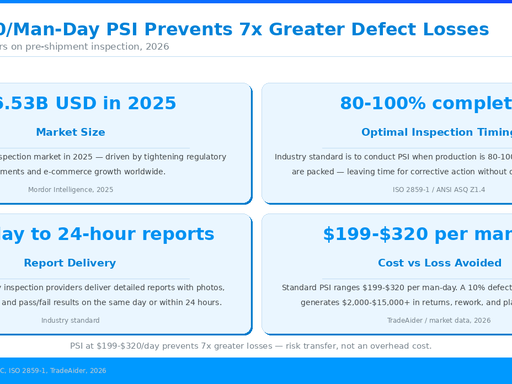
Based on 2026 market rates: daily inspector rates in China range USD 130‑320 per man‑day; all‑in packages including travel sit reasonably at USD 199‑268.
Price reference for major providers: ‑ QIMA: starting from USD 229/man‑day across most Chinese provinces; higher‑cost hubs such as Shanghai and Guangzhou near USD 299. ‑ V‑Trust: standard all‑in rate USD 268/man‑day; travel and weekend surcharges apply separately; reports issued within 24 hours. ‑ SGS & Bureau Veritas: USD 300‑400/man‑day, better suited when accredited laboratory testing and high‑regulatory‑market validation are required. ‑ Intertek: pricing bracket comparable to SGS and Bureau Veritas.
Q: What share of total order value does this represent?
For a USD 15 000 consignment, a USD 268 inspection equals 1.8 % of cargo value. For a USD 100 000 shipment this drops to 0.27 %.
Now consider the financial impact of border rejection in the EU: Refrigerated container detention fees at Rotterdam or Hamburg run EUR 150‑300 per day. Repatriation freight for a 40ft reefer container can easily exceed EUR 3000. These represent only direct expenses. Vegetables have shelf‑lives measured in days; delays of merely five days may render the whole consignment commercially worthless.
Equally consequential are lasting RASFF‑record effects. Once a supplier appears on RASFF notifications, subsequent consignments from that source face intensified border‑inspection frequencies. For certain vegetable categories the EU already applies enhanced‑check regimes to Chinese produce with elevated sampling rates. Negative notification impacts can persist through an entire growing season.
Q: How should we interpret the trade‑off: spending USD 300 to avoid losing USD 15 000?
Field‑validated industry experience: a USD 268 pre‑shipment inspection acts as 1.8 %‑cost insurance for a USD 15 000 order. If non‑compliance surfaces post‑arrival, vessel rescheduling may add one‑to‑two‑week delays. For fresh vegetables such delays commonly erase the commercial viability of the full shipment.
The practical question is not whether inspection expenditure is worthwhile, but whether you can afford the consequences of omitting it.
How to organise inspection effectively
Q: At which stage should inspection take place?
Industry best practice: inspect once 80‑100 % of production is complete and at least 80 % of goods are packed into cases. V‑Trust operational guidance recommends booking at least two working days in advance. This gives buyers time to review reports and decide on release or corrective‑action negotiations.
Full logistics timeline incorporating freight‑forwarder constraints: schedule inspection 3‑5 working days ahead; build a 2‑3‑day buffer before carrier cut‑off dates. Inspections booked too late leave no window for rework or replacement upon failure, resulting in missed vessel sailing.
Core principle: inspection serves as a critical decision checkpoint, not a procedural box‑ticking exercise. If your supplier refuses to preserve a one‑to‑two‑day buffer between inspection completion and cut‑off, risk‑control value is largely lost.
Q: How do I select an inspection provider?
Match your choice to business objectives: ‑ QIMA: well‑suited for small‑to‑medium importers. Convenient online booking, 24‑hour App‑delivered reports including photos and clear pass/fail summaries; base rate USD 229/man‑day for most provinces. ‑ V‑Trust: cost‑effective option. Operates 25+ offices across China with over 420 full‑time inspectors; all‑in rate USD 268/man‑day excluding travel‑weekend surcharges; 24‑hour report turnaround. ‑ SGS & Bureau Veritas: preferred where well‑known‑brand accreditation is required. Their factory‑audit outputs carry strong recognition among large‑format retail buyers. Drawbacks include higher pricing (USD 300‑400/man‑day) and longer lead‑times for appointments.
Critical qualification check: if pesticide‑residue laboratory testing forms part of your scope, confirm the provider holds proven capability against EU MRL requirements. Not all inspection houses deliver this, especially smaller local firms. While SGS and Bureau Veritas hold ISO 17020 accreditation as a baseline, always verify exact analyte coverage lists.
Different inspection strategies for first‑time versus repeat orders
Q: Should inspection protocols stay identical for first and second shipments?
Protocols do not need full duplication, yet inspection priority is highest for initial orders.
For first‑ or second‑time orders in the EUR 20 000‑50 000 value bracket: pre‑shipment inspection is strongly advisable. Costs typically represent 1‑1.5 % of order value, yet drastically reduce the risk of costly post‑arrival discoveries. The expenditure buys you the option to halt or remediate shipments before containers depart origin.
For consignments above EUR 100 000: inspection costs become proportionally low and should be embedded as standard operating procedure. In these cases you may specify the inspection certificate as a required document under Letter‑of‑Credit terms, delegating validation to your bank prior to payment release.
For repeat shipments with previously validated suppliers: inspection frequency may be reduced but should never be eliminated entirely. Compliance risks are not static: orchards may change, pesticide programmes can shift, and EU MRL regulations are subject to revision. Periodic spot‑check sampling remains prudent.
Q: Are there relevant regulatory trends to watch?
One noteworthy development: EU regulations permit pre‑export compliance checks performed in third countries under defined conditions. Article 15 of Commission Implementing Regulation (EU) No 543/2011 establishes this legal framework. China does not currently benefit from such official recognition for most fresh‑vegetable categories. Even so, suppliers maintaining thorough pre‑shipment‑inspection documentation will hold an advantageous position should such schemes expand in future.
Pre‑shipment inspection is not an act of distrust toward suppliers. It represents the only independent tool available to EU fresh‑produce buyers for verifying compliance while goods remain within the country‑of‑origin jurisdiction. Once containers load onto vessels you are left only to wait and hope. Inspection costs amount to a fraction of cargo value (0.x %‑1.x %), yet skipping inspection exposes you to total cargo‑value loss, port‑incurred charges and persistent RASFF‑alert consequences affecting your whole procurement season.