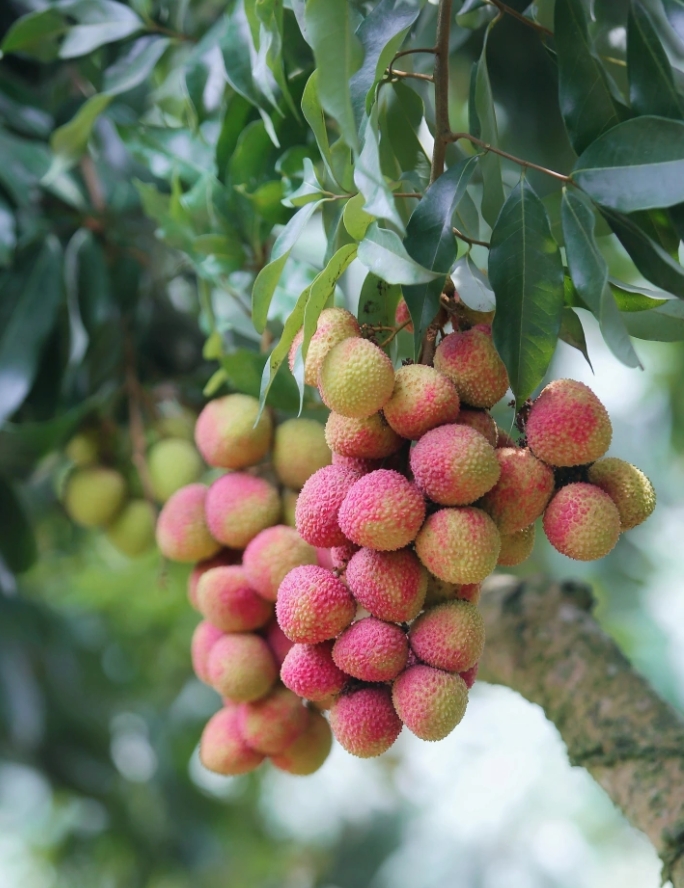
Ideal Harvest Maturity for Export-Grade Feizixiao Lychee
The harvesting maturity of concubine laughing lychees directly determines how much this batch of goods will be worth after it arrives in Europe. If the fruit is picked early, the fruit is not fully developed, and the flavor is sour. Consumers will not buy it a second time if they take a bite; If it is picked late, the flesh will lose sugar, the flavor will fade, and it will start to brown and rot before the sea is halfway through. From the perspective of the importer's actual operation, this article sorts out the criteria for judging the maturity of Feizixiao's export, the timeliness requirements for postharvest processing, and the compliance data that must be checked before arriving at Hong Kong according to the logic of procurement decision-making.
The harvest window of FEIZIXIAO Lychee is narrower than most people think
The peel of “FEIZIXIAO" undergoes changes from green to light red and then to bright red during the ripening process, but this change process is not uniform. The fruit on the same tree may have turned red on the sunny side, but still green on the shaded side. If the supplier only judges the maturity based on "looks red", the actual maturity of the fruits in the same batch may vary by several grades.
A patented technology from the Fruit Tree Research Institute of the Guangdong Academy of Agricultural Sciences gives a more reliable basis for judgment. The research team tested Feizixiao, which had reached transportation maturity, in two production areas, Lianjiang and Gaozhou. The pH value of Lianjiang Feizixiao was 4.50, and the pH value of Gaozhou Feizixiao was 4.55. The fruits in both production areas were in The exocarp has just begun to be colored, and the endocarp is still white, with a sugar content of 15.0% and 15.1% respectively. This maturity corresponds to the 8.5 maturity of Concubine Smile.
Earlier studies have also measured the ratio of reducing sugar to sucrose. Under the unified maturity standard, the ratio of reducing sugar to sucrose in Lianjiang, Gaozhou, Dianbai, Yangxi and Guangzhou production areas is 8.17: 1, 7.92: 1, 8.02: 1, 7.96: 1, 8.12: 1, respectively. The analysis results are very close. In the absence of a unified standard, the ratios measured by different researchers vary greatly, some are 2.92: 1, and some are even greater than 100: 1. This shows that if the supplier does not have a clear collection standard, the maturity consistency of the same batch cannot be guaranteed at all.
The export orchard in Pubei, Guangxi implements the principle of "picking at seven ripens and entering the factory within 2 hours". Fruit farmers lightly pinch the fruit stalks without damaging the peel, ensuring that each export lychee has a correct fruit shape, red and green, and white flesh. jade. The export base in Hejiang, Sichuan only harvests seven or eight mature fruits, and the picking time is up to 5 hours a day, from 5:00 am to 10:00 am. If you pick it early, the dew is too big, and the taste of lychees is not good; Pick late and the fruit temperature is too high, which will lead to a change in smell or accelerated decay.
In practice, the importer can require the supplier to provide the harvest record of the orchard in the purchase contract, indicating the proportion of peel coloration, soluble solids content and pH value. For suppliers who cannot produce these data, it is best to be cautious about the goods in the future.
The 4 hours after harvest determine how much shelf life is left .The harvest window of Concubine Smile is narrow, and the time window for postharvest treatment is even narrower.
The operating standard of the Hejiang lychee export base is: from picking the branches to loading them into refrigerated trucks, to primary processing, pre-cooling, and until they are sent to the refrigerated storage, the whole process shall not exceed 4 hours. Pubei Export Orchard has built a full-chain fresh-keeping system of "pre-cooling at the place of origin-cold chain transportation-cold storage at the place of sale". The county's refrigerated fresh-keeping storage capacity exceeds 20,000 cubic meters. After picking lychees, they are pre-cooled with ice water, sorted and packaged, 60 minutes Enter the quick-freezing warehouse to lock the freshness, and lock the freshness period for 30 days.
The Maoming production area has made technical upgrades in postharvest pre-cooling. Local enterprises cooperate with the Academy of Agricultural Sciences to build a fresh-keeping technology system, optimize the pressure difference pre-cooling process, and reduce the temperature of lychee core from room temperature to below 6 °C within 2 hours, which is 30% to 50% higher than the pre-cooling efficiency, and locks from the source Freshness.
A 2026 study from Sun Yat-sen University provides more granular data. In this study, three kinds of lychees, Feizixiao, Guiwei and Huaizhi, were used as materials, pre-cooled in ice water at 4 °C for 15 minutes, and then packaged in modified atmosphere bags and stored at 25 °C. The results showed that ice water pre-cooling was suitable for conceizixiao and osmanthus-flavored lychee.
There are also clear data on the modified atmosphere storage parameters of Feizixiao. Feizixiao, which is packaged with a volume fraction of 5% CO ₂, 5% O ₂, and 90% N ₂, is stored for 42 days under refrigeration conditions at 4 ± 1 °C. The good fruit rate of the commodity reaches more than 90%, and the browning index is 1.52. Maintain the original color and quality of lychees. The modified atmosphere preservation effect of Feizixiao is to extend the storage period by about two weeks.
For importers, the actual meaning of these data is: it is not superfluous to require suppliers to provide post-harvest pre-cooling time nodes and core temperature records in the procurement contract. From 4 hours in Hejiang to 60 minutes in Pubei, the time node can be written into the contract and verified batch by batch.
The maturity is right, and the compliance data arriving inharbour cannot be dropped.The maturity is well controlled, and the postharvest cold chain is also in place. There is another hurdle that must be focused on: pesticide residues in the EU.
On May 4, 2026, Italy notified through RASFF that various pesticide residues in fresh lychees exported to China exceeded the standard, and the notification number was 2026.3912. Chlorfenapyr was 0.037 ± 0. 019 mg/kg, lambda-cyhalothrin 0.12 ± 0. 06 mg/kg, chlorfenamide 0.5 ± 0. 25 mg/kg, lufenuron 0.25 ± 0. 13 mg/kg, enoylmorpholine 0.063 ± 0. 032 mg/kg, frommilwil 0.11 ± 0. 06 mg/kg, iproniazid 0.075 ± 0. 038 mg/kg, the maximum residues of the above pesticides were 0.01 mg/kg. Spirofenate 0.27 ± 0. 14 mg/kg, fluridinamide 0.028 ± 0. 014 mg/kg, pyrazolimide 0.053 ± 0. 027 mg/kg, with a maximum residue of 0.02 mg/kg. The product has stopped being put on the market and has been notified to the competent department. The type of notification is notice information notification.
Litchi is already a recurring category in RASFF pesticide residue notifications. The Czech Republic notified that the litchi exported from Vietnam was unqualified through RASFF, and the detection of lambda-cyhalothrin was 0.56 mg/kg, clothiamethoxam was 0.15 mg/kg, clothiamethoxam was 0.037 mg/kg, and the maximum residue was 0.01 mg/kg. These notification records fall in the name of the importer, and the loss is also borne by the importer.
The entry of lychees into the EU requires a phytosanitary certificate, which is issued by the national plant protection agency of the exporting country. The certificate needs to prove that the lychee has been properly inspected, does not contain quarantine pests, and meets EU plant health requirements. The European side has no special specifications for packing boxes, but if there are ventilation holes in packaging materials, it is recommended to seal with a yarn net with a hole diameter of less than 1.6 mm.
The importer needs to clearly require the supplier to conduct testing in accordance with the EU MRL standard in the procurement contract. The testing report is issued by a qualified third-party organization. The testing items cover the pesticide varieties commonly used on lychees, and not only one or two types can be inspected. The EU Pesticide Residue Database can be consulted on the official website of the European Commission, and importers can confirm the requirements of target pesticides in advance.
Checklist for Purchasing Manager
Before the shipment of Feizixiao, confirm that the orchard harvest records provided by the supplier indicate the peel coloring ratio, soluble solid content and pH value. The reference range for transportation maturity is pH value 4.50 to 4.55, sugar content about 15.0%, endocarp Still white. Suppliers are required to provide post-harvest pre-cooling time nodes and core temperature records, and the time from picking to cold storage is controlled within 4 hours. It is confirmed that the pesticide residue detection report of each batch of arrivals covers the pesticides of concern to the EU, and the measured value is lower than the corresponding MRL, especially chlorfenapyr, lambda-cyhalothrin, chlorfenamide, and lufenuron. Varieties that appear repeatedly in RASFF notifications. Confirm that the phytosanitary certificate is issued by the official phytosanitary agency of the exporting country, and that the ventilation holes of the packing box are closed with a yarn If the supplier is from the Hainan production area, confirm in advance whether the harvest date is affected by the high temperature and advanced.
The core of Feizixiao's maturity management in Europe is to replace it with data. Eight-ripe harvesting, pre-cooling within 4 hours after harvesting, and continuous cold chain throughout the whole process, these three links are interlocking. Pesticide residue compliance is the bottom line, and the test report of each batch of goods must be checked. If you are importing Feizixiao lychees from China, or want to systematically sort out the supplier's harvesting and cold chain standards, please contact us for a harvest maturity checklist and EU MRL quick check form for the Feizixiao category.