Pomelo Cold-chain Standard for Sea Freight China-EU: Storage Temperature & Packaging
Chinese pomelo is gaining fast traction in the European market. Industry statistics forecast China’s honey pomelo export volume will hit 250,000 tons in 2025, rising 25% year-on-year. The EU market accounts for roughly 45% of total exports, with Germany and the Netherlands being the two largest consuming countries. Exporters based in Pinghe County, Fujian have already secured 15,000 tons of European orders alone, marking a 150% year-on-year increase.
Yet for you as an EU buyer, higher export volumes also mean greater hidden risks. Pomelo spends more than 20 days at sea. Any breakdown in cold chain management can cut its post-arrival shelf life in half. Worse still, Chinese pomelo is listed for 20% border inspection by EU authorities, meaning one in every five consignments is randomly selected for pesticide residue testing. As the importer, you hold primary legal responsibility for food safety. If the cargo is condemned and destroyed, all losses fall on you.
This guide breaks down EU cold-chain requirements for sea-freighted pomelo from the buyer’s perspective, covering temperature settings, packaging specifications, port inspection rules, and non-negotiable contract clauses.
Why Pomelo Is Sea-Freight Viable — But Risks Still Lie On The Ocean
Pomelo and lychee operate under completely different supply chain logic. Lychee has an extremely narrow fresh-keeping window and must travel by air. Pomelo, by contrast, is a non-climacteric citrus fruit with very low endogenous ethylene production. Its thick peel acts as a natural protective layer, giving it far longer storage potential than most tropical fruits.
Per Maersk commodity data, pomelo can be stored for 63–70 days at 6–8°C with maximum air exchange set at 30 m³/h. This unique trait makes pomelo one of the few fresh commodities suitable for long ocean transit from China to the EU. However, the thick peel carries a hidden risk: cold-chain failures trigger internal decay that remains hidden under intact rind. By the time you unpack the cartons, rot may already have started from the fruit core, leaving you unsure whether the batch can be released for retail.
Storage Temperature: The First Parameter To Lock Into Your Contract
There are multiple competing temperature theories circulating in the industry. Without clear standards, suppliers may rely on vague claims such as “this is how we always ship.”
Maersk’s official commodity guide recommends 6–8°C transit temperature, maximum air exchange of 30 m³/h, with a 63–70 day theoretical shelf life. Research on Guanxi honey pomelo storage suggests whole fruit storage at 3–5°C and RH 80–90%, with rapid pre-cooling to bring fruit core temperature below 5°C within 72 hours after harvest. In real commercial practice, freshly harvested pomelo must be pre-cooled at origin to bring core temperature down below 5°C within a 72-hour window.
Variety and growing-region climate cause these discrepancies. For mainstream cultivars including Zhangzhou Guanxi honey pomelo and Chongqing Liangping pomelo, 6–8°C is the field-proven safe setting. Temperatures below 3°C risk chilling injury: sunken peel and necrotic oil glands. Above 12°C, fruit respiration accelerates, peel shrivels from water loss, and internal quality deteriorates rapidly.
As a buyer, pre-cooling records are your top priority. After harvesting, pomelo must undergo pre-cooling at the packing house. Only once core temperature reaches the target range can fruit be loaded into the reefer container. You cannot rely on the reefer container to “cool down during transit.” Pomelo shipped without proper pre-cooling creates heavy temperature stratification inside cartons. Fruit near container doors may heat up, while the sensor reading appears normal. Cold-chain disruptions rarely happen mid-voyage; they occur at handover links from origin farm to port: delayed refrigerated trucks, faulty reefer sockets at the terminal, or waiting periods during transshipment. Any of these can trigger quality degradation before the vessel even departs.
Your contract must explicitly require suppliers to submit pre-cooling temperature logs prior to loading. Without valid records, you reserve the right to reject the shipment. Do not accept verbal assurances like “our shipments always arrive fine.”
The most common destination port for Chinese pomelo exports to the EU is Rotterdam in the Netherlands. It is Europe’s largest reefer hub with dedicated cold terminals and plant health inspection facilities. After customs clearance in Rotterdam, pomelo can be distributed freely to all EU member states. Other popular ports include Antwerp (Belgium), Hamburg (Germany), Valencia (Spain) and Genoa (Italy). Northern European ports are widely chosen for pomelo shipments, while Mediterranean ports serve buyers in Spain, Italy and the Balkan region.
Packaging Standard: Non-compliant Packaging Will Block Customs Entry
Pomelo packaging directly impacts cold air circulation inside cartons and prevents mechanical damage. Packaging is also a key item checked during EU border inspections.
Heavy-duty corrugated cartons must have engineered ventilation holes. These holes allow chilled air to flow through stacked pallets and release CO₂ produced by fruit respiration, avoiding condensation. Vent hole size and placement must be designed based on pallet stacking patterns and airflow direction; randomly punched holes are insufficient. If condensation is found inside cartons upon receiving goods, it indicates the supplier failed to follow packaging standards.
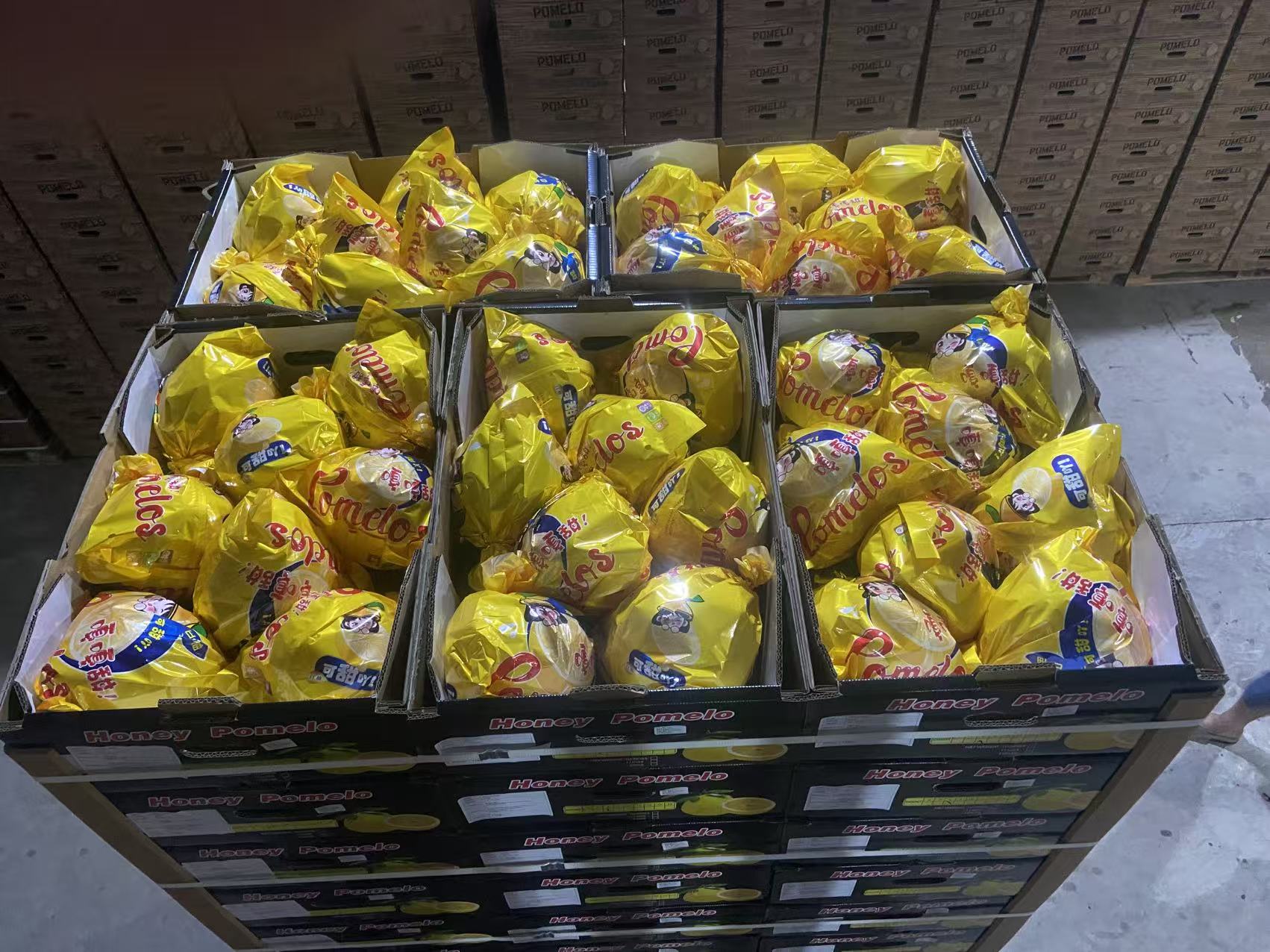
Honey pomelo bound for the EU requires intact peel. Standard practice is to wrap each fruit individually with foam net sleeves or thin film bags before packing into corrugated cartons. Pinghe exporters widely adopt eco-friendly packaging: net protection, barcode and label application, then carton sorting by fruit size. Some suppliers are replacing plastic film with plant-based edible coating technology such as PlantSeal, which reduces transpiration and respiration without plastic wrapping.
The EU enforces specific marketing standards for citrus fruits. Under Regulation (EU) 2023/2429, pomelo must be intact, clean, pest-free, free of chilling injury, and withstand transport and handling. Outer packaging must carry origin marking. Starting January 1, 2025, pomelo marketing standards are fully aligned with UNECE rules, with more detailed packaging and labeling requirements. Pomelo, limes and grapefruits all fall under EU citrus marketing standards. Poorly labelled cargo may be deemed untraceable at EU ports and refused entry. This means you must verify label contents before shipment, instead of trying to add labels after arrival.
EU Port Inspection: 20% Official Control Rate, No Way To Avoid
Chinese pomelo is a high-focus commodity for EU border authorities, and you need to plan for this upfront.
Under Annex I of EU Regulation 669/2009, Chinese pomelo is listed for intensified official controls, with a 20% inspection rate targeting pesticide residues. One out of five consignments will be sampled for laboratory residue analysis. Sampled goods must wait for lab clearance before release, and the costs of intensified official controls are borne by the operator — namely you. Operators must pre-notify port authorities at least one day before vessel arrival and submit CHED-PP entry documents.
RASFF alert history deserves every EU buyer’s full attention. On 24 October 2025, the Netherlands issued a RASFF notification for Chinese pomelo containing unauthorised chlorpyrifos at 0.033 mg/kg, exceeding the EU MRL of 0.01 mg/kg by more than three times. In March 2022, Romania detected furathiocarb 0.042 mg/kg, isoprocarb 0.045 mg/kg and lufenuron 0.012 mg/kg — all unapproved active substances in the EU. Romania also reported chlorpyrifos at 0.056 mg/kg in another pomelo batch the same year. Ireland notified excess chlorpyrifos in Chinese pomelo in March 2024, and Germany previously issued alerts in 2021 over prochloraz and chlorpyrifos violations.
The outcome for these cases is definitive: goods are destroyed or withdrawn from market, with all costs charged to the importer. If detected pesticides are not authorised under EU regulations, the default MRL is 0.01 mg/kg. You must require suppliers to provide batch-specific third-party pesticide residue test reports before shipment. Test panels need to cover EU priority pesticides including chlorpyrifos, furathiocarb, isoprocarb, lufenuron and methyl parathion. Do not accept the claim “ISO certification means everything is fine.” ISO certification does not guarantee MRL compliance for individual produce batches.
New Rule for Temperature Recorder: Digital Logging Mandatory From 2026
EU rules for cold-chain temperature documentation are tightening rapidly, directly affecting your customs clearance speed.
Starting January 2026, the EU requires digital temperature records across all cold-chain nodes; paper logs will no longer be accepted. This update comes from revisions to the ATP (Agreement on the International Transport of Perishable Foodstuffs). The 2025 ATP handbook enters force on 25 August 2026, imposing stricter technical standards for data loggers: loggers must comply with EN 12830:2018 and calibrated at two measurement points per EN 13486.
For you, this means confirming with your freight forwarder during booking: whether data loggers support digital export, whether file formats meet EU requirements, and data retention periods as mandated by regulation. Your carrier or forwarder must supply the complete temperature trajectory file from loading to EU port arrival, including timestamps and readings. Missing records risk detention and supplementary document checks at customs. Every extra day pomelo sits at port accumulates demurrage and quality loss.
Four clauses you have to lock in the purchase
Writing cold-chain standards into your procurement contract is far more effective than chasing compensation after quality failures.
Temperature setting & pre-cooling recordsThe contract defines pre-loading target core temperature (6–8°C, fine-tuned by variety) and obliges suppliers to deliver pre-cooling logs. Without valid pre-cooling records, you retain the right to reject the batch.
Full temperature trajectory dataSuppliers must provide full temperature logs covering the entire journey from origin cold storage to EU port, compliant with ATP 2026 requirements, with data intervals no longer than 15 minutes. Continuous temperature deviation over 2 hours counts as supplier breach.
Packing specification confirmationClarify ventilation hole design, carton weight, fruit count per carton, and label content (origin mark, orchard registration number, packhouse code, batch number). Mis-labelled shipments risk being deemed untraceable and refused entry.
Pre-shipment pesticide residue testingSuppliers must supply batch-specific third-party residue test reports covering EU priority pesticides. Failed batches cannot be shipped, and testing cost allocation is agreed upfront.
Arrival Acceptance: Check Data First, Then Visual Inspection
When cargo arrives at your warehouse, validate data before physical inspection.
Review full temperature trajectory. Readings should stay stable within ±1°C of the setpoint. Multiple temperature spikes, even if pomelo looks visually intact, may indicate internal water loss or incipient decay, requiring reassessment of shelf life.
Inspect pallet stacking. Leave gaps between cartons and between pallets and container walls to allow airflow from floor channels. Stacking that blocks airflow creates temperature stratification, pushing actual fruit temperature far above the setpoint.
Sampling inspection. Open random cartons and check peel for chilling injury depressions, oil gland necrosis or mould spots. Use a probe thermometer to measure fruit core temperature. If core temperature exceeds the setpoint by more than 2°C, re-evaluate shelf life for the whole consignment.
Shipping pomelo to the EU is not about speed, but consistent cold-chain execution. Every stage matters: origin pre-cooling, ventilated packaging, reefer temperature setup, and continuous digital temperature logging. Enshrining these standards in your contract and enforcing them during acceptance is the foundation of profitable pomelo imports.