
How Seasonal Variation Impacts Pesticide Residues: Three Variables EU Buyers Need to Understand
Claims such as “pesticide residues are higher in summer” or “winter produce is safer” have almost no practical value for EU import procurement. Real risk does not stem from the season itself. It depends on which active substances are applied to a specific crop in a specific growing region, the interval between pesticide application and harvest, and any post-harvest treatments carried out after picking.
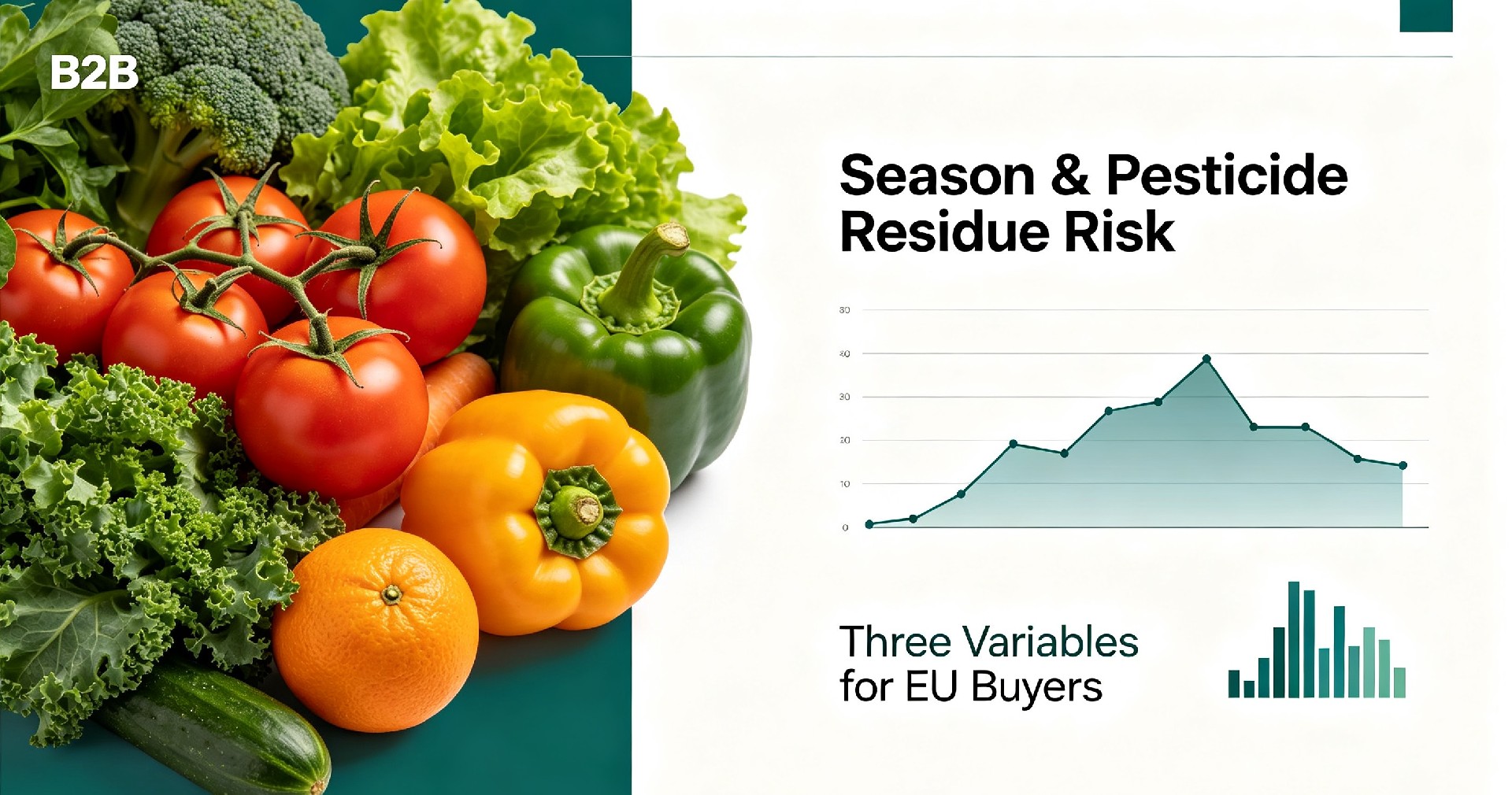
When combining RASFF rejection statistics and EFSA monitoring reports, seasonal patterns are clearly observable. An analysis of RASFF alerts for Turkish horticultural exports between 2020 and 2025, covering 1,138 notifications and 1,660 residue detections, found that rejections peaked in winter and spring, particularly for citrus and greenhouse-grown crops. Yet the root causes are far more complex than simply “more pests mean more pesticide sprays”. For EU buyers, understanding these mechanisms matters more than memorising high-risk seasons, as procurement decisions are finalised months before shipment, not at the point of border inspection.
Variable 1: Calendar effects of crop protection strategies
Pest and disease pressure shifts seasonally for every crop, directly shaping spray frequency and application windows. However, heavier pesticide use does not automatically lead to residue exceedance. The critical factor is whether the interval between the final application and harvest is long enough for residues to degrade below the MRL.
The aforementioned MDPI study highlights a notable finding: chlorpyrifos and methyl chlorpyrifos remain among the most frequently detected residues in Turkish export goods, even though these substances are banned in the EU. Researchers attribute this to continued use of old stockpiles, illegal product circulation, and the high environmental persistence of these active ingredients. This means residues may still be detected in the next growing season, even if suppliers claim they have stopped using them.
Citrus rejections are concentrated in winter and spring, aligning with the Northern Hemisphere citrus harvest window. Protective sprays applied shortly before harvest often leave only a few days of waiting time before picking, yet some active substances have persistence levels exceeding this interval. Field trials measuring chlorpyrifos behaviour on tomatoes recorded half-lives of 4.95 days for unwashed small fruit and 4.33 days for large fruit. If the pre-harvest interval is not strictly respected, residues can easily exceed MRLs at harvest.
This pattern is not consistent across all crops. A HBM4EU biomonitoring study conducted across five European countries — Latvia, Hungary, Czechia, Spain and the Netherlands — measured acetamiprid in human urine. Detection rates in Latvia and Netherlands were lower during summer sampling than in the second sampling round. The study authors explicitly stated that the difference could not be attributed solely to seasonal changes in crop residues, and that further research into seasonal shifts in dietary intake was required. In other words, seasonal signals are mixed. Variations may reflect consumers eating fruit sourced from different origins in different seasons, rather than changing residue levels in produce from the same supplier.
For EU buyers, this translates to a clear operational rule: do not set blanket procurement thresholds based purely on season. Risk assessment must be built around the combination of crop × growing region × active substance. Summer-harvested grapes from the Southern Hemisphere follow a completely different risk profile to winter-harvested Northern Hemisphere citrus.
Variable 2: Post-harvest treatment and storage — the illusion of detection timing
Citrus is the commodity most often misunderstood when examining links between season and pesticide residues. Post-harvest fungicides including imazalil, prochloraz and thiabendazole are widely applied to citrus to prevent spoilage during long-distance shipping and storage. These fungicides are highly persistent. The waxy peel of citrus fruit readily absorbs lipophilic pesticides, concentrating residue levels far higher in the peel than in the flesh.
A 2026 written parliamentary reply from the European Parliament provides concrete monitoring data: out of 38,169 samples tested for imazalil (including whole fruit with peel), only 35 samples returned residue levels above the MRL. The most recent imazalil MRL update was adopted in 2020, based on EFSA’s 2019 scientific opinion. In August 2025, EFSA released a new assessment based on residue trials for oranges and mandarins, proposing to raise the MRL for all citrus fruit to 7 mg/kg. EFSA also concluded that short-term and long-term consumer exposure to residues from these uses is unlikely to pose a health risk.
This creates a critical timing confusion. Northern Hemisphere citrus is harvested in winter, yet stocks can remain available on the market through spring and into early summer. The winter‑spring peak in citrus RASFF notifications may in fact represent the same winter-harvested fruit being sampled at later dates, rather than rising residues caused by seasonal change after harvest. The adjustment of imazalil MRL from a stricter limit to EFSA’s proposed 7 mg/kg demonstrates that residue management for post-harvest treatments sits within an evolving regulatory landscape.
For EU buyers, the practical takeaway: when sourcing stored citrus from Northern or Southern Hemisphere stock in spring, verify not only field application records, but also the type of post-harvest fungicides used, application method and total storage duration. Longer storage increases the chance of detecting post-harvest fungicide residues, but this risk is tied to the time between treatment and delivery, not the calendar season.
Variable 3: Physicochemical effects of climate on residue degradation
Temperature, rainfall and sunlight directly determine how quickly pesticides break down on crop surfaces. This effect is most pronounced for leafy vegetables.
One field trial conducted in Beijing tested dissipation behaviour of five pesticides — thiophanate-methyl, metalaxyl, fluazifop-p-butyl, chlorpyrifos and lambda-cyhalothrin — across six leafy vegetable types: pak choi, rape, garland chrysanthemum, amaranth, spinach and lettuce. The results were definitive: maximum residue concentrations across all six vegetables were higher in autumn than summer. For most tested pesticides, the half-life was longer in autumn. Researchers attributed this difference to the direct impact of environmental conditions: light intensity, heat, moisture and rainfall control degradation rates, alongside properties of the plant matrix itself.
Identical spray programmes can degrade below MRL limits before harvest in hot summer weather, yet remain non-compliant in cooler autumn conditions. This is not because farmers apply more pesticide in autumn, but because climate slows residue breakdown.
This mechanism also applies to suppliers in the Southern Hemisphere. Chilean, Peruvian and South African grape harvest seasons are offset from the Northern Hemisphere. High summer temperatures in those regions may accelerate breakdown of certain active substances, while heat stress can also increase pest pressure and push growers to shorten application intervals. The net outcome cannot be inferred from season alone. It must be evaluated using local climate data and degradation kinetics for each pesticide.
For EU buyers, the operational implication: verifying that a supplier follows GAP is not sufficient for risk control. The same GAP protocol can yield very different residue outcomes under different climatic conditions. A pre-harvest interval that works reliably in Chile’s central valleys may not be suitable for Peru’s coastal growing areas.
What these variables mean for procurement decisions
Translate these three variables into actionable procurement steps:
Avoid setting purchasing thresholds based purely on calendar seasons. EFSA’s 2024 monitoring report reviewed 86,449 samples. 96% contained no detectable residues or residues at or below the MRL, with non-compliant samples accounting for just 1.8%. This compliance rate shows no direct statistical correlation with season. The real drivers of risk for any given shipment are supplier spray records, adherence to pre-harvest intervals and post-harvest handling procedures.
Include post-harvest treatment review within your contract checks. For long-storage crops such as citrus and apples, require suppliers to provide a list of post-harvest fungicides used and their application dates before shipment. The history of imazalil MRL revisions demonstrates that regulations for this category continue to evolve. Relying on “this is how the supplier has always operated” is insufficient for risk management. EU rules require labelling disclosure when peels are treated with fungicides, preservatives or additives. Where imazalil is applied, labels must carry the mandatory warning “peel not for consumption”. This labelling requirement acts as a simple check to confirm full disclosure of post-harvest treatments.
For leafy greens and berries, obtain the date of the last pesticide application and the name of all active substances used before harvest. Residue half-life data is publicly available — chlorpyrifos on tomatoes has a half-life of roughly 4–5 days — yet compliance with pre-harvest waiting periods can only be validated by cross-checking documentation and laboratory sampling. Seasons change degradation rates, but the MRL compliance threshold remains fixed.
Seasonal shifts do affect pesticide residue detection patterns, but not through simple rules like “hotter equals higher residues” or “colder equals safer”. Three mechanisms operate in parallel: crop protection planning aligned to growing cycles, post-harvest handling practices, and climate-driven physicochemical breakdown of active substances. For EU buyers, risk management should focus less on avoiding procurement in certain seasons and more on demanding traceable field and post-harvest documentation from suppliers, cross-referenced against border laboratory results. A region with a history of winter RASFF alerts may have substantially reduced risk in the next harvest season if suppliers change active substances and adjust pre-harvest intervals — a change that cannot be identified merely by looking at the season.