
How should one choose pear varieties when importing from China?
Below is a detailed overview of Chinese pear export varieties, covering appearance, texture, sweetness, shelf life, and practical transportation recommendations. All temperature, humidity, and controlled atmosphere (CA) parameters follow standard agricultural storage guidelines. Sugar content and storage duration may vary by region, harvest year, postharvest pre-cooling, and packaging; therefore, pricing upon arrival should be based on actual testing of each shipment.
**Variety: Yali Pear (Pearl Pear)**
Ovoid to nearly-shaped (gourd-like), yellow-green turning pale yellow after storage; often has a duck-head-like bump at the stem end. Average fruit weight: 180–250g. Crisp texture, juicy, mild flavor with few stone cells. Sweetness: 11.5–13°Brix. Storage: refrigerate at around 0.5°C, humidity above 90%. Can be stored for several months in cold storage, but prolonged storage increases risk of core browning.
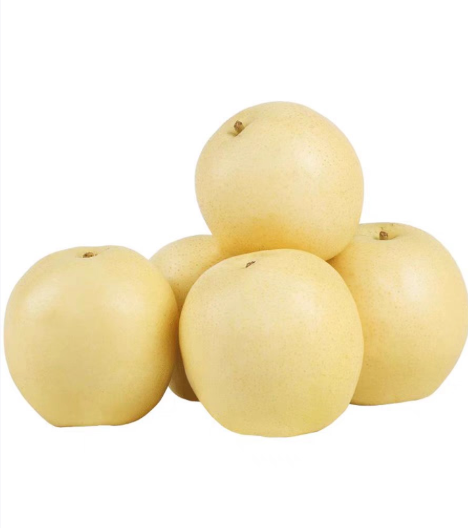
**Variety: Crown Pear / Huangguan Pear – Supermarket Volume Type**
Crown pears are slightly lighter yellow, while Huangguan pears are more golden. Both are high-round shaped with fine lenticels and clean, attractive appearance. For export, consistency in color, absence of russeting, and stable single-fruit weight range are critical.
Texture: crisp, white flesh, low stone cell count, tender and smooth without grit, highly juicy—widely accepted as a "safe" choice with minimal risk. Huangguan pears are typically yellower and sweeter than Crown pears, while Crown pears offer a fresher, cleaner taste.
Crown pears: sweetness ~12.8–14.2°Brix, total sugar 9.6g/100g, organic acid 0.18g/100g—high sugar-to-acid ratio, resulting in a clean, sweet flavor. Huangguan pears can reach up to 0.5–1° higher in some regions.
Storage: -1~0°C, humidity 90–95%. CA storage requires caution with high CO₂ levels to prevent core browning. Easier to manage than Yali pears, but more sensitive to long-term high CO₂ compared to Qiuyue or Xiangli pears.
**Variety: Snowflake Pear / Xueli Pear – Long Shelf Life & Processing Dual Use**
Larger-sized fruit, skin ranges from yellow-green to yellow-white, sometimes with coarse lenticels. Similar types exist in Zhaozhou/Shijiazhuang area of Hebei, Shanxi, and Dangshan, Jiangsu. For fresh export, select fruits with clean skin, no black spots, and no mechanical damage.
Texture: relatively firm flesh, less delicate than Crown pears, but with strong "rock sugar" sensation. Excellent for stewing—retains structure and produces gelatinous texture, ideal for pear soup, canned products, and pear syrup. Stone cell count is higher than Crown pears, which some consumers perceive as slightly coarser.
Sweetness: ~12.0–13.5°Brix—moderately sweet with noticeable aftertaste.
Storage: 0–1°C, humidity 90–95%. Suitable for long-term storage and off-season supply. Gradual cooling and humidity control help prevent wrinkling; use low CO₂ in CA storage.
**Korla Fragrant Pear – Small Fruit, High Aroma, Premium Boxed Product**
Small-sized fruit, oval to inverted ovate or spindle-shaped, thin skin with small, dense lenticels, yellow-green with red tints. Traditionally graded into “female pears” (round, without stamen scars) and “male pears,” though export focuses more on uniformity, absence of insect scars, and sunburn.
Thin skin, fine flesh, crisp and refreshing, very juicy. Its defining feature is its intense fragrance—“fragrant” rather than merely sweet. Reports indicate high water content and extremely low stone cell count.
Soluble solids typically 13–15%; initially crisp when harvested, becomes softer and more aromatic after 5–7 days at ambient temperature.
Storage: not below -1.2°C. CA conditions: O₂ 4–5%, CO₂ 1–2% (some studies suggest O₂ 3–5%, CO₂ 1–3%, adjusted per warehouse type). Can be stored for months at 0–4°C; professional cold storage extends shelf life until April–June next year, and CA storage even longer. Pre-cool immediately after harvest; individual netting recommended to prevent bruising.
**Qiuyue Pear – Large Premium Fruit, Bursting with Juice and Pure Sweetness**
Flat-round shape, yellow-brown skin; lower russeting indicates better quality. Large fruit size; exported in grades of 250g+, 350g+, and 450g+.
Texture: exceptionally fine flesh, almost seedless, juiciest among varieties, low acidity, pure sweetness—ideal for premium fresh consumption. However, overripe fruit loses firmness and becomes mealy.
Producers commonly sort by sweetness of 13–14.5°Brix; top-quality fruit can exceed this. Sweeter than Yali and Crown pears, more consistent than Fengshui pears.
Storage: 0±1°C, humidity 90–95%. CA storage can use low O₂, but CO₂ must be strictly limited to avoid core browning. Autumn Moon is not as tolerant of high CO₂ as Fragrant Pear, nor does it require extreme staged cooling like Duck Pear, but sufficient pre-cooling is essential.
Yulu Xiang – A premium hybrid of Fragrant Pear and Snowflake
Near-spherical in shape, yellow-green turning yellow after storage with a red blush on the sun-exposed side; thin skin and small core. Average weight 237g, large fruit up to 450g—ideal for export selection at 300–400g.
Crisp and juicy with no grit, exceptionally sweet and aromatic, combining the fragrance of Fragrant Pear with the thick flesh of Snowflake, representing the new generation of premium white pears.
The hybrid parentage ensures high sugar content and fresh aroma, typically ranging from 13–15° Brix—sweeter than regular Snowflake and with thicker flesh than pure Fragrant Pear.
Can be stored for 6–8 months in constant-temperature cold storage; manage at 0±1°C with high humidity and low CO₂ controlled atmosphere. Due to its thin skin, use net sleeves plus inner liners during packaging to prevent bruising and browning during transport.
Toyosu, Golden, and Xin Gao – Japanese-style texture from the Sand Pear series
Toyosu: Brown-yellow skin, very juicy, slightly soft, high sweetness (Brix 13–14.5°), but average storability and transportability, suitable for short-distance or refrigerated express delivery; accepted by Southeast Asian, Japanese, and Korean supermarkets.
Golden: Golden-yellow skin, extremely smooth and fine-textured, high sugar content; however, thin skin prone to browning and sensitive to CO₂. Store at 0–2°C with 85–90% humidity, keep CA CO₂ below 3%, and use individual fruit film to prevent browning. Ideal for premium boxed packaging, but avoid prolonged exposure to high CO₂.
Xin Gao: Long oval, yellow-brown, slightly more storage-tolerant than Toyosu, richly sweet with thick flesh and abundant juice, ideal for wholesale of larger fruits.