
What products are most likely to trigger EU RASFF alerts?
EU buyers sourcing fresh produce from China have almost all heard of RASFF, but few truly understand how it works. Most perceive it merely as news about "goods being detained at ports," rather than as a data system that can be used to reverse-engineer a procurement risk map.
RASFF (the Rapid Alert System for Food and Feed) recorded 10,490 alerts throughout 2025, an 11% increase compared to 2024. Beneath this overall growth trend, fruit and vegetable products accounted for 18% of all notifications, with pesticide residues being the most prominent risk category. A more critical figure is that 78% of all products notified due to pesticide residues originated from non-EU countries.
This means that when your goods are blocked in Rotterdam or Hamburg, the trigger for the alert is likely not "the product itself being defective," but rather "the product failing to meet the EU's specific maximum residue limits for certain active substances." The distinction between these two scenarios determines what you should verify before shipment.
Q1: What product categories are currently most frequently notified by RASFF?
According to notification data from 2026, Chinese agricultural and food exports to the EU continue to face high levels of alerts. For example, in April 2026, RASFF reported 21 cases involving Chinese agricultural and food products exported to the EU—11 rejections at entry, five information notices, and four warnings. The main reasons for these notifications were excessive pesticide residues, detection of environmental pollutants, pathogenic microorganisms, and heavy metal contamination.
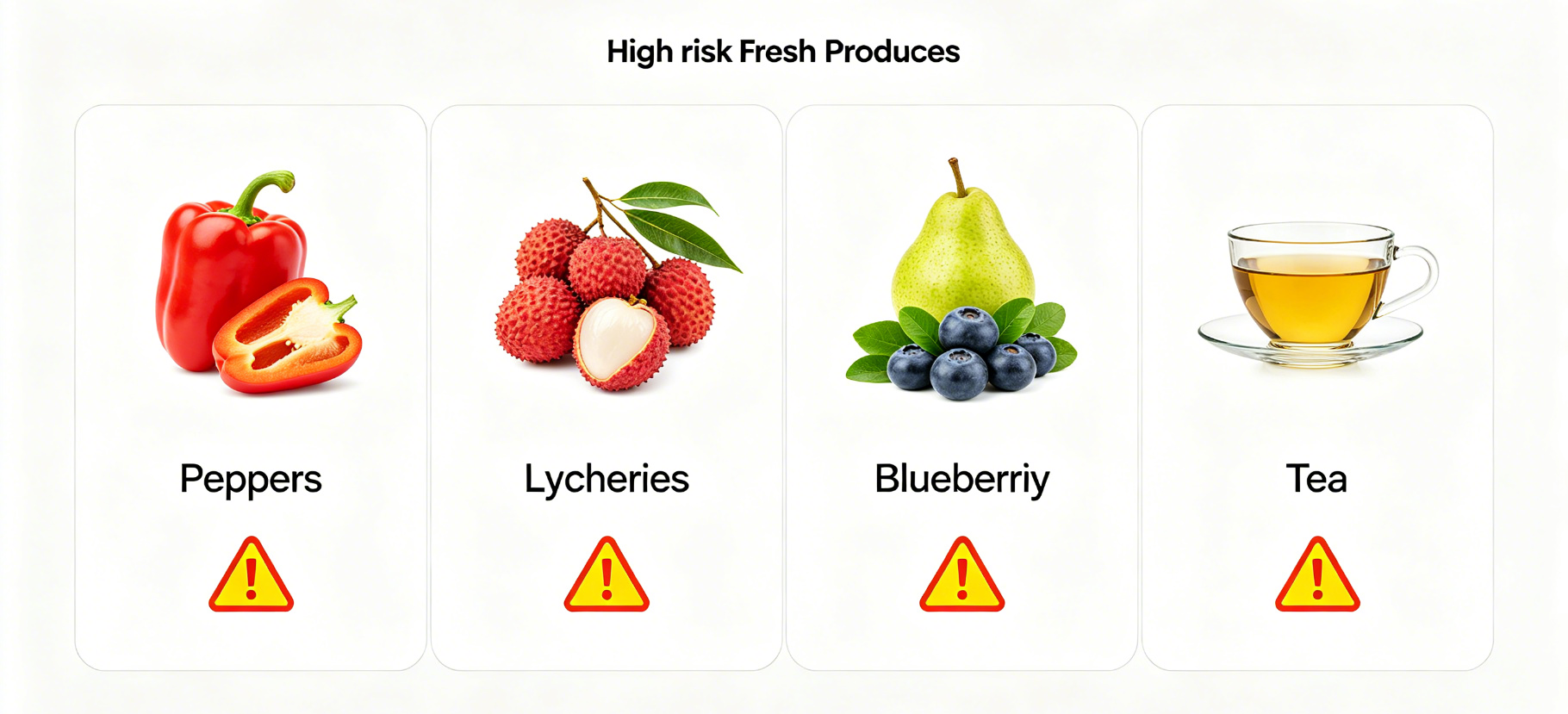
In terms of product categories, vegetables, fruits, nuts, seeds, and tea consistently rank among the top notified items. Since 2020, vegetables and fruits have steadily ranked among the highest notified product groups across all RASFF categories.
Q2: Which specific products are most prone to triggering alerts, and which active substances are involved?
Below are specific cases from 2025 to 2026 where Chinese products exported to the EU were notified by RASFF, categorized by product type:
Vegetables
Frozen bell peppers were one of the most problematic categories in 2026 notifications. On April 1, 2026, Belgium reported a batch of frozen bell peppers containing multiple pesticide residues exceeding maximum residue levels (MRLs): flupyradifurone (0.67 mg/kg, MRL 0.3 mg/kg), dinotefuran (0.041 mg/kg), thiamethoxam (0.022 mg/kg), etoxazole (0.020 mg/kg), iprodione (0.011 mg/kg), and lufenuron (0.016 mg/kg, MRL 0.01 mg/kg). All six active substances exceeded their respective limits. Later that month, Spain reported another batch of peppers due to the presence of Salmonella.
Fruits
Fresh lychees were the focus of notifications in 2026. On May 4, 2026, Italy reported Chinese fresh lychees contaminated with nine pesticide residues: chlorfenapyr, deltamethrin, chlorantraniliprole, fenpropimorph, zoxamide, fluopyram, fosetyl-aluminum, iprodione, and pyraclostrobin, along with the unauthorized substance spiromesifen. Detected levels included chlorfenapyr at 0.037±0.019 mg/kg, deltamethrin at 0.12±0.06 mg/kg, and chlorantraniliprole at 0.5±0.25 mg/kg—all far exceeding the established MRLs of 0.01 mg/kg. On July 6, 2026, the Netherlands issued another alert for Chinese-exported lychees, reporting exceedances of acetamiprid, azoxystrobin, chlorantraniliprole, chlorpyrifos, clothianidin, zoxamide, lufenuron, cyflufenamid, pyraclostrobin, and prochloraz, under notification number 2026.5933.
Regarding Laiyang pears, on March 24, 2026, the Netherlands reported that Chinese-exported Laiyang pears were found to contain chlorfenapyr (0.17 mg/kg), bifenthrin (0.052±0.026 mg/kg), dinotefuran (0.066±0.033 mg/kg), etoxazole (0.063±0.032 mg/kg), and indoxacarb (0.040±0.020 mg/kg). The maximum residue limits (MRLs) for all these active substances are set at 0.01 mg/kg.
Regarding frozen blueberries, on March 12, 2026, Poland reported that Chinese-exported frozen blueberries exceeded the permitted levels of iprodione and cypermethrin. The notification number was 2026.2068, and the products were seized.
Tea and Herbal Products
Tea is a key focus in EU pesticide residue monitoring. In March 2026, France reported that Chinese-exported tea contained metamitron (0.18 mg/kg), leading to refusal of entry. Spain reported green tea containing dinotefuran (>0.026±0.013 mg/kg), which also resulted in rejection. In April 2026, both Poland and the Netherlands reported Chinese green tea containing thiamethoxam, cyfluthrin (0.035 mg/kg±0.018), imidacloprid (0.36 mg/kg±0.18), clopyralid (0.099 mg/kg±0.050), dianuron (0.10 mg/kg±0.050), and thiamethoxam, as well as the unapproved substance chlorpyrifos.
Other Categories
In April 2026, Spain reported that Chinese-exported cumin powder contained the unapproved substance chlorpyrifos (0.405±0.203 mg/kg); however, the goods were allowed to proceed to their destination after being sealed by customs. In the first week of 2026, Slovenia reported that fresh truffles exported from China exceeded the cadmium limit (detected level: 1.4 mg/kg, MRL: 0.5 mg/kg).
Q3: Why are these products particularly prone to triggering alerts?
The root cause lies in structural differences between China's domestic standards and the EU's MRL system.
For pesticides not approved for use on specific crops, the EU applies a default MRL of 0.01 mg/kg. This rule originates from EU Regulation (EC) No 396/2005: if a pesticide has not been registered or assessed for a particular crop within the EU, and no specific MRL has been established, then it is uniformly subject to a control threshold of 0.01 mg/kg.
Limits in China’s GB standards are often significantly more lenient. For example, the MRL for dinotefuran in dried tea leaves under Chinese standards is 10 mg/kg, while the EU’s default threshold is 0.01 mg/kg—a difference of 1,000-fold. Similarly, there is a significant discrepancy for acetamiprid in tea—China’s standard allows up to 10 mg/kg, whereas the revised EU standard in 2014 sets it at 0.05 mg/kg.
Moreover, frequent revisions to EU MRL standards reduce predictability for trade compliance. Since its implementation, Regulation (EC) No 396/2005 has undergone nearly 200 revisions by the end of 2022. In 2020, the EU withdrew the registration authorization for chlorpyrifos, subsequently removing its MRL, thereby lowering the allowable residue level for this substance across agricultural products to 0.01 mg/kg. This change directly impacted exports of Chinese agricultural products to the EU after 2021.
Q4: How does the number of testing items in the EU compare with China’s?
The EU conducts screening for nearly 500 pesticide residues in tea-related products, while China's GB2763-2026 national standard sets maximum residue limits (MRLs) for dried tea at just 112 items. The more parameters screened, the higher the likelihood that a product will exceed one of these strict thresholds.
According to EFSA data, official EU laboratories test over 740 different pesticides annually and report approximately 26 million individual pesticide residue test results each year. This indicates that the EU’s testing system significantly differs from China’s routine export inspections in both coverage and analytical depth. A product deemed "compliant" in China may still be rejected at EU borders due to an active substance permitted in China but not approved by the EU.
Q5: How can EU buyers protect themselves?
Verify supplier qualifications. Before signing contracts, require suppliers to provide customs registration information for orchards and packing facilities exporting fruit. Orchard registration requires contiguous cultivation, no nearby pollution sources, a plant protection officer responsible for monitoring and controlling pests, a quality management system, and no major plant disease outbreaks in the past two years. Packing facilities must have quarantine-compliant cleaning, processing, and pest control equipment; water used in processing and agricultural chemicals must meet importing country requirements, and they must establish a quality management system covering the entire supply chain—from sourcing to processing, packaging, storage, and transportation. Registration certificates are valid for three years, and renewal applications must be submitted three months before expiration.
Conduct MRL-specific testing. Require suppliers to provide specialized test reports for specific active substances mentioned in RASFF historical notifications prior to shipment. For example, if purchasing frozen bell peppers from China, test reports must cover six active substances: flonicamid, dinotefuran, thiamethoxam, etoxazole, iprodione, and zolpidone. For fresh litchis, testing should include chlorfenapyr, lambda-cyhalothrin, chlorantraniliprole, lufenuron, zoxamide, fosetyl-aluminum, iprodione, spiromesifen, fluopyram, and pyraclostrobin. For tea, focus on chlorpyrifos, acetamiprid, thiamethoxam, tebuconazole, flonicamid, and triflumuron.
Choose testing institutions with EU MRL capabilities. Not all third-party inspection companies are equipped to perform tests according to EU MRL standards. If your testing provider cannot confirm that its methods are validated under EU MRL guidelines, the validity of a “pass” result at EU ports will be significantly reduced.
Include testing scope in contracts. Clearly list in the contract the list of active substances involved in RASFF historical notifications for the relevant product category, requiring suppliers to provide item-by-item test reports prior to shipment, with detection limits below the corresponding EU MRLs. For substances like 4-CPA, which are not approved by the EU, the detection limit must reach 0.01 mg/kg or lower. This step costs only a few hundred dollars but greatly reduces the risk of discovering issues upon arrival.
A proven principle in procurement is this: the “compliance” you see is based on Chinese standards, whereas EU border controls apply a completely different set of rules. Testing must align with EU MRLs, not China’s GB standards.