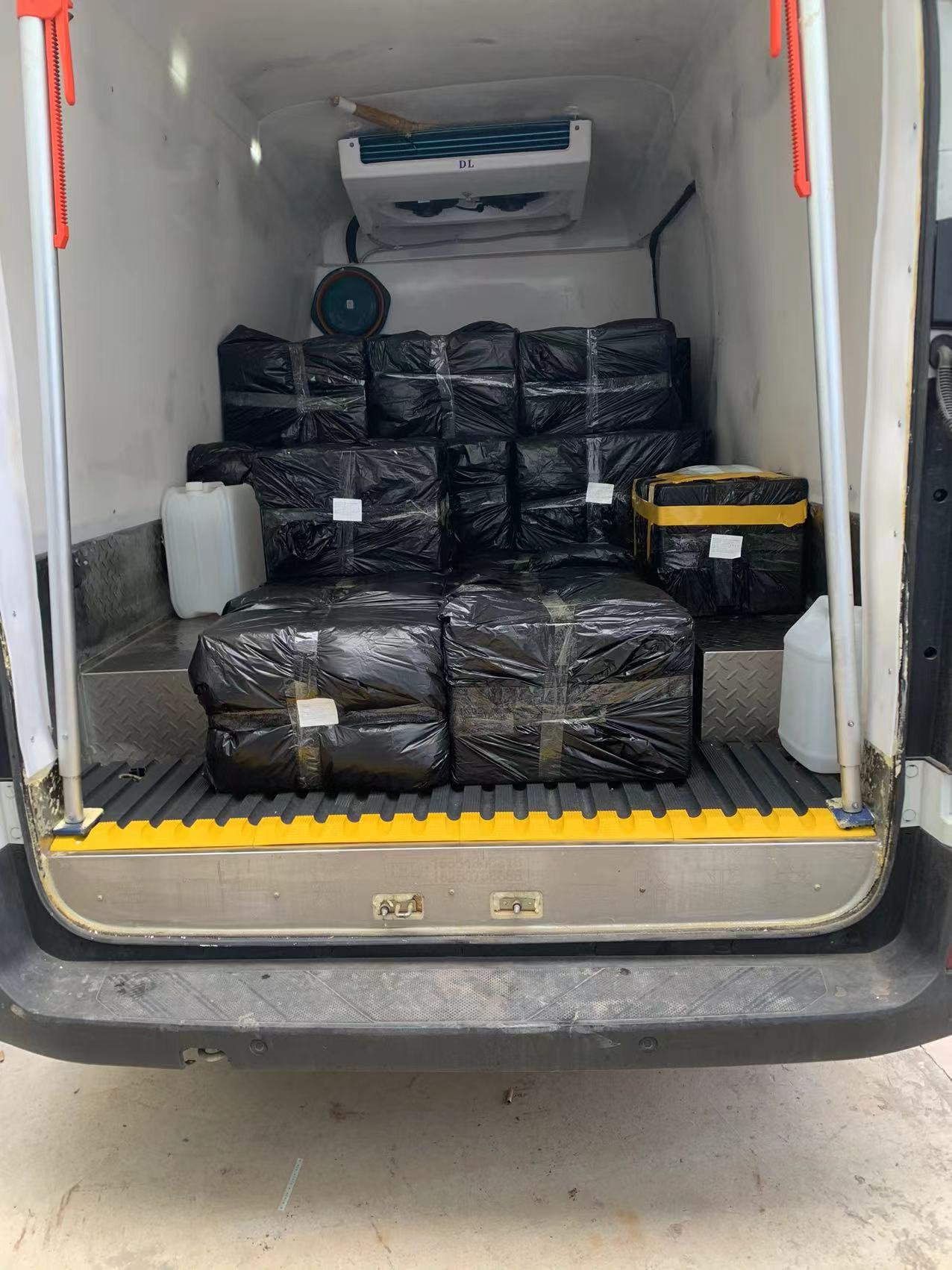
What loading guidelines reduce fruit compression damage for pear cartons inside the reefer container?
The global cold chain logistics market continues to expand, with fruits and vegetables being one of the largest application segments. However, losses during fresh fruit transportation remain severe. Industry data shows that cross-border return rates for perishable goods have long remained between 8% and 15%, with approximately 40% of product damage occurring not during ocean transit but at container yards prior to shipment. China's total loss rate across its entire fruit supply chain reaches 13.2%, and without full cold chain monitoring, transport loss rates for fresh fruit can even reach 30%. Data from 2025 indicates that China’s cold chain circulation rate for fruits and vegetables is only around 35%, far below the over 90% level seen in developed countries, while cold chain loss rates remain as high as 20% to 30%.
Compression damage is the leading cause of fruit spoilage. Once cardboard boxes deform under pressure inside refrigerated containers, pears may develop dents, browning, or even rapid decay. More problematic is that if pears experience continuous vibration during transit, their firmness significantly decreases, making them more vulnerable to damage under stacking pressure. Based on the latest research findings, this article systematically breaks down loading guidelines for shipping pears in refrigerated containers to help you effectively reduce compression damage.
1. Why Are Pears Prone to Damage in Cold Containers?
Many people assume pears are hard enough to withstand pressure, but the conditions pears face during transport are far more complex than we imagine.
A study conducted on Crown pears using random vibration tests found that after vibration, pear firmness decreased by 9% to 26%. As firmness drops, the fruit’s ability to resist pressure diminishes—weights previously tolerated now become unbearable. This softening due to vibration alone is bad enough; when combined with stacking pressure, damage becomes almost inevitable.
Another often-overlooked issue is the position of pears within the container. A study on Huanghua pears during transport revealed significant differences in damage between the front and rear sections of the container. The average damaged surface area was 2.97% in the front section versus 8.49% in the rear; the number of damaged pears was 10.7 in the front and 14.4 in the rear. Pears in the rear suffer more because they exhibit higher activity of pectin methylesterase and polygalacturonase enzymes, which rapidly break down pectin in cell walls, causing faster softening. In other words, transport vibrations not only cause mechanical damage but also negatively affect storage quality upon arrival.
There’s another hidden threat: resonance. South Korean researchers studied the resonant characteristics of export pears and found their resonance frequency range lies between 49.04 and 87.16 Hz. When the natural frequency of the packaging system matches the vibration frequency during transport, the acceleration experienced by pears can multiply dramatically, sharply increasing damage. This explains why sometimes the cartons appear intact, yet the pears inside are severely damaged.
Of course, the most common causes remain familiar issues: cardboard boxes absorb moisture in the high-humidity marine environment, becoming softer and losing compressive strength; excessive stacking height crushes bottom layers beyond recovery; inadequate pre-cooling before loading leaves fruit carrying field heat into the container, triggering condensation and further dampening the boxes; overly tight stacking restricts air circulation, raising local temperatures and intensifying fruit respiration, which softens the flesh. These factors compound, ultimately resulting in widespread cargo damage upon arrival.
2. What Should Be Done During Loading?
Packaging serves as the first line of defense for protecting pears. Export-grade pear boxes cannot be chosen casually. In the high-humidity environment of long-distance sea freight, the bursting strength of standard corrugated board drops by over 40%, and fiber moisture absorption leads to exponential decline in stacking strength. A reliable industry practice is to use five-layer AB-flute corrugated board paired with high-weight face paper, and if possible, moisture-resistant coated paper or water-repellent treated corrugated material. The edge crush test (ECT) strength should be no less than 7.0 kN/m, and the safety factor for cold chain transportation should range between 5 and 7—significantly higher than the typical 3 to 5 used in standard dry cargo transport.
Inner packaging is equally important. A study on static load testing of Crown pears packed in EPE (expanded polyethylene) net sleeves provides clear evidence. Compared to unpacked pears, those wrapped in EPE nets showed a 3.5-fold increase in displacement before initial damage occurred, with improvements of 3.5 times, 2.9 times, and 2.3 times in lateral, longitudinal, and diagonal directions respectively. Under 15 mm compression, the static pressure endured by EPE-packed pears was reduced by 76.1%, 74.4%, and 51.0% respectively, while damage area and volume percentages were both kept below 5%. These figures indicate that the cost of a single net sleeve translates into a significant reduction in product loss.
Another detail worth noting is the orientation of pear placement. Mechanical studies on Korla fragrant pears show that when pears are placed longitudinally, their biological yield limit is 135.91 N, deformation energy is 521 N·mm, failure limit is 177.07 N, and failure energy is 942 N·mm. In contrast, the yield limit drops to only 105.98 N when placed horizontally. Pears exhibit significantly greater resistance to mechanical damage when loaded longitudinally. Therefore, during packing, always arrange pears vertically rather than randomly tossing them in for convenience.
Pre-cooling deserves special attention. Pears must be pre-cooled to 4–8°C within 24 hours after harvest, with a pre-cooling duration of 6 to 12 hours. Insufficient pre-cooling causes fruit to enter storage still warm, leading to excessive condensation inside the container. This dampens cardboard boxes, softening them and drastically reducing their compressive strength. Research from Wageningen University in the Netherlands shows that fruit weight loss during transport ranges from 1.40% to 3.06%, averaging 2.33%; adequate pre-cooling can effectively reduce this rate.
Palletizing method directly affects cargo stability during transit. The fundamental principle is staggered stacking—avoid aligning seams between upper and lower layers, instead offsetting them like bricklaying. If seams line up vertically, the stack becomes prone to shifting or collapse during transport vibrations, causing repeated compression of bottom-tier pears.
Stack height should be calculated based on the box’s compressive strength. The formula is: safe BCT value = total stack weight × safety factor, where the safety factor ranges from 4.0 to 6.0. In refrigerated containers, stack height should generally not exceed the red loading line marked inside the container. Studies also reveal that the natural frequency of pears is inversely proportional to the height of the fruit column: as fruit depth decreases from about 60 cm to 30 cm, natural frequency increases from 30 Hz to 50 Hz. This means that stack height not only impacts the load-bearing capacity of bottom boxes but also alters the entire stack’s vibration response characteristics—the taller the stack, the higher the risk of resonance.
Air circulation pathways must never be compromised. Refrigerated containers rely on T-shaped floors to push cold air upward from the bottom. Cold air passes through gaps between goods, absorbs heat, and returns via top return air ducts to the evaporator. If stacks are too dense, airflow cannot circulate properly, causing localized temperature increases. This intensifies fruit respiration, softens flesh, and further reduces compressive strength. At least 10–15 cm clearance should be maintained between the top of the stack and the container ceiling to ensure smooth air flow. International shipping guidelines clearly recommend evenly distributing cargo across the entire T-floor surface to maximize air circulation efficiency.
All voids must be filled—air bags are excellent tools.
Even with perfectly aligned stacking, gaps will inevitably form between the cargo stack and the container walls. If these gaps are left unattended, the jolts during transportation will cause the cargo stacks to shift back and forth, leading to collisions and compression.
Inflatable airbags are currently recognized as one of the most effective reinforcement solutions. Made from PE film, they are soft in texture and provide excellent cushioning and shock absorption when inflated. Placed between the cargo and the container walls, they expand to offer strong support. Studies show that fruits packed with inflatable airbags exhibit a 20% to 40% higher maximum yield limit under pressure compared to those without cushioning materials, and their deformation is significantly less under the same load.
In practice, all gaps between the cargo stack and the container doors or side walls must be filled with airbags. For partial container loads, airbags alone are insufficient—wooden blocks, support rods, or specialized strapping must also be used to secure the stack and prevent movement in any direction.
Temperature and humidity should be set according to the variety
Different pear varieties have varying requirements for temperature and humidity, so a one-size-fits-all approach won't work. Crown pears are sensitive to low temperatures; optimal long-term storage is 0–1°C with relative humidity maintained at 90%–95%. The ideal refrigeration temperature for Yali pears is also 0–1°C, with a required humidity of 95%. Snow pears are best stored at 0–1°C with 90%–95% relative humidity. Golden pears are recommended to be stored at 0–1°C, with a storage period of 4–5 months. Yuanhuang pears also require 0–1°C and can be stored for 4–5 months.
For international transport, the South African pear export guidelines recommend a shipping temperature of -0.5°C and a relative humidity of 90%–95%. When loading containers, the fruit core temperature must not exceed the set temperature by more than 2°C. The guidelines emphasize a critical point: refrigerated containers are transport units, not mobile cold rooms, and their cooling capacity is limited—they can only gradually lower fruit temperatures. Therefore, pre-cooling before loading is decisive.
Before sealing the container, review these key points:
Are the cartons dry and undamaged, with sufficient edge crush strength? Has the fruit been properly pre-cooled, and has the core temperature reached the target? Is the stacking neat, with seams staggered between layers, and is there adequate space for cold air circulation at the top of the stack? Are the fruits primarily loaded vertically to optimize stress distribution? Have airbags been used to fill gaps between the cargo stack and container walls or doors? Are the temperature, humidity, and ventilation settings of the cold container matched to the specific pear variety being shipped? After closing the door, is the refrigeration unit operating normally? These may seem like minor details, but each directly affects the final product loss rate.
3. How much can you actually save by investing this money?
Many exporters view pre-cooling, airbags, and high-strength cartons as additional costs and tend to cut corners where possible. But a simple calculation reveals the truth. Assuming each containerload of exported pears is worth $50,000, and the industry average product loss rate ranges from 5% to 15%, losses per container range from $2,500 to $7,500. If EPE net sleeves are used for packaging, damage can be kept below 5%, and combined with staggered stacking and airbag reinforcement, the loss rate can be minimized. For a company exporting 50 containers annually, potential savings could amount to between $125,000 and $375,000 per year.
This isn’t just theoretical—real-world cases confirm it. After a smart cold storage facility was launched in Guangshui, Hubei Province, pear loss rates dropped from 20% to below 5%. Industry-standardized operations have reduced spoilage rates for perishable goods from around 10% to 2.1%, while for key products such as lychees, the reduction in transit spoilage exceeds 70%. The potential for cost reduction and efficiency gains through refined cold chain management is far greater than many imagine.
4. The business value behind the data
Quantifying cargo damage costs: Assuming each container of exported pears is valued at $50,000, with an industry average cargo loss rate of 5%–15%, losses per container range from approximately $2,500 to $7,500. By adopting a combined solution—EPE net wrapping (keeping damage area below 5%) + interlocking stacking + inflatable bag reinforcement—the damage rate can be minimized. For a company exporting 50 containers annually, this approach could recover annual losses amounting to $125,000–$375,000. According to packaging engineering research from 2024, EPE netting reduces compressive force by 51.0% to 76.1% and keeps damage area under 5%. Without monitoring, cold chain transportation loss rates can reach as high as 30%, while the total loss rate across the entire fruit supply chain stands at 13.2%, based on data from the China Chain Store Association in 2024.
Reducing compression damage to pears during refrigerated container transport is ultimately a systematic process involving packaging, pre-cooling, stacking, reinforcement, and temperature control. Behind every set of data lies real financial loss and profit erosion. By thoroughly implementing this loading guide based on actual data, exporters can significantly reduce fruit damage rates and simultaneously build brand reputation in overseas markets. If you require customized cold chain loading solutions for specific pear varieties—such as Autumn Moon pears or Korla Fragrant Pears—please contact us for detailed cold chain logistics technical support.